
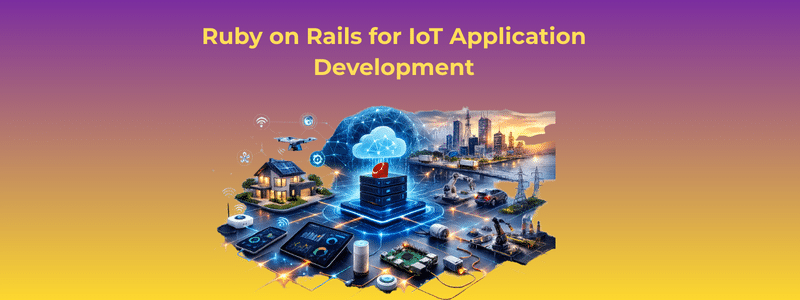
By 2026, the Internet of Things (IoT) will bring new industrial advantages by allowing them to seamlessly connect devices, sensors, and digital systems. With a broad range of such applications from smart homes and health monitoring to logistics automation and industrial analytics, IoT applications are getting more sophisticated, utilizing data more than ever. At its core, each successful IoT ecosystem is supported by a sophisticated backend that manages huge amounts of data streams, secure communication, and real-time processing.
Although conversation around IoT is generally around hardware and edge computing, backend frameworks play an important role in bringing the scalability and performance to the platform. Ruby on Rails used to be famous only for web development, but now it has emerged as an interesting option to develop a complete IoT platform, especially concerning API management, dashboards, analytics, and data orchestration.
In this post, we will discuss how Ruby on Rails enables us to develop IoT applications by 2026, and about its pros, approaches with the architecture, and challenges, along with reasons why companies have still been betting on it for contemporary connected systems.
IoT Application Development in 2026 Explained
And there’s more to IoT applications than just connected devices. An IoT architecture consists of several tiers that coexist:
- Edge Devices and Sensors for Data Collection
- Network protocols such as HTTP or MQTT, or WebSockets
- Back-end servers for authentication and processing
- Databases for storing device information
- Monitoring and control on dashboards or mobile apps
Ultimately, as more and more of IoT is adopted in the field, backend systems will need to keep track of millions of products that rely on every data point working all the time. Ruby on Rails is a natural fit in this model as it encourages the rapid creation of scalable APIs and organized backend logic.
Why Ruby on Rails is still relevant for IoT projects
In 2026, businesses want fast development and maintainability as well, and performance is still important. We continue to be excited about Ruby on Rails because it encourages convention over configuration, making it possible to produce complex applications with fewer lines of code, allowing easy-to-maintain code bases.
Rails is particularly well-suited for IoT work because:
- It simplifies API development
- It supports rapid prototyping
- It has a natural fit in cloud infrastructure.
- It offers strong community support
Since IoT environments are increasingly software-based, Rails has proven to be a solid server-side foundation that speeds up development.
Ruby on Rails in IoT Architecture
You would not find RoR installed on IoT devices. It doesn’t act as the final backend infrastructure of your product (it connects devices, users, and data).
API-First Development for Connected Devices
Today’s IoT platforms are API-driven. RB: Rails has an API only mode, which lets you create a slim backend service dedicated to transferring data. Telemetry data can reach Rails APIs, and processed information is available on mobile apps and dashboards.
This API-based method helps organizations scale their IoT platform without having to develop core infrastructure from scratch.
Data Management and Analytics
IoT systems produce massive amounts of sonic and unsupervised data. Rails makes database management easier via its Active Record facility, which allows user data tobe stored and queried easily.
With Rails, teams can build:
- Data ingestion pipelines
- Reporting dashboards
- Historical analytics tools
It helps to take the raw sensor data and turn it into actionable business insights.
Real-Time Communication and Monitoring
The real-time transmission in 2026 plays an essential role in IoT applications. Websockets are supported out of the box and enables real time framewoks which will let you to create a dashboard that updates itself when connected devices do stuff.
Examples include:
- Smart home control panels
- Industrial equipment monitoring
- Healthcare alert systems
Real-time features enable companies to react to problems swiftly and operate more efficiently.
Advantages of Leveraging Ruby on Rails for IoT Projects
Faster Development Cycles
It’s no secret that IoT startups and companies require speed to get to market. Rails makes the development process faster thanks to development tools, scaffolding, and a proper framework. Now developers can concentrate on business logic instead of routine configuration duties.
The faster you develop the more quickly you can release your MVPs and optimize for speed of testing.
Scalable API Infrastructure
Increased Traffic on Backend Systems As more devices are connected to an IoT platform, the backend systems must deal with higher loads. Rails embraces a modular and scalable design via background processing, caching, and microservices. This means that applications are stable as long as you have more devices.
Clean and Maintainable Codebase
Rails is based on the Model-View-Controller (MVC) pattern, a design principle that keeps the application logic limited to three interconnected components. For IoT development organizations, this architecture facilitates teamwork between developers without complicating the maintenance over time.
A well-structured codebase minimizes technical debt and secures the possibility of adding new features without touching existing ones.
Strong Integration Capabilities
IoT systems often need to interact with several third-party services: cloud storage, analytics platforms or mobile applications. It can be leveraged for integration through plugins or API’s that help any business create interconnected systems without the burden of complexity.
Built-In Security Features
Security is a great problem in IoT systems. Rails comes with several built-in security features, including authentication systems and encapsulation of data from common vulnerabilities. These capabilities enable developers to create secure IoT backends that keep user data and device communication safe.
Typical IoT Use Cases with Ruby on Rails
Smart Home Automation Platforms
Developers can also now create a single dashboard to control lights, security and energy using Rails. Devices can be monitored via mobile apps, and the back end logic and data handling is Rails.
Healthcare IoT Applications
Interconnected medical devices generate constant flows of patient information. Rails assists with store safe, analytic and alert systems to allow healthcare providers to receive timely updates.
Industrial IoT and Manufacturing
Manufacturers depend on sensors to keep tabs on how equipment is running. Dashboard Analytics and Maintenance Tracking Systems – Rails support included for added operational enhancement without downtime.
Logistics and Fleet Management
Recording vehicles and consignments with IoT devices. With Rails, backend systems power route analysis data, optimize logistics workflows and serve up live updates to customers.
Disadvantages of Ruby on Rails for IoT
Although phenomenal in a lot of ways, Rails isn’t perfect for everything.
Handling Extremely High Data Throughput
If you have IoT systems and hundreds of millions data streaming in real-time, you may need other technologies (like message queues or streaming platforms) in addition to Rails. Performance becomes critical, and you must optimize database queries and background jobs.
Concurrency and Scaling Complexity
Rails can scale, but you might need microservices or similar to cope with very large IoT systems. Early planning and infrastructure are essential.
Not Designed for Embedded Systems
Rails isn’t really meant to be running directly on devices; it’s mostly for backend development. So in general, such device-side programming is supported by edge computing solutions or for even for lightweight firmware.
Building IoT applications with Ruby on Rails Best Practices
Adopt an API-First Approach
Architect your IoT platform as a set of APIs, providing interfaces for devices, apps and dashboards to communicate flawlessly.
Use Background Processing
Asynchronous tasks, like processing data or sending a notification in IoT platforms. Supporting background job systems can also make it so we don’t sacrifice as much in the way of performance/responsiveness.
Optimize Database Strategy
Selecting the appropriate database structure is very important for effectively managing IoT data. If the datasets get big, indexing and data partitioning can really help with run time.
Begin with Security in Mind
Reliable authentication, secure communication, and authorization schemes are necessary to safeguard the connected devices and user’s information.
Emerging Ruby on Rails IoT Development Trends in 2026
Microservices Architecture
A lot of IoT platforms are migrating towards a modular system where Rails handles just the backend part of something. This makes scaling easier and allows teams to release services independently.
AI and Data Analytics Integration
IoT platforms are being integrated with machine learning for predictive maintenance and analytics. Rails is the cog in the machine that takes data pipelines and visualization tools and marries them.
Cloud-Native Development
Cloud infrastructure Web servers that run Railsアプリケーション tend to be deployed in the cloud, where they can scale as needed and offer access from around the world. Cloud-native design that keeps IoT platforms robust and flexible.
Native Backend Alternatives – Ruby on Rails vs.
Some businesses consider Node. js or Python libraries for IoT back ends. However, Rails still holds its own due to what it provides for developer productivity and organisation, and has a mature ecosystem.
Other frameworks may be faster, but Rails is the best fit for most situations due to speed of development and maintainability over time.
The Future of Ruby on Rails with IoT in 2026 and Beyond
As IoT is growing, the backend system for it needs to grow as well. Ruby on Rails ramps up with performance. The open source web application framework has enhanced its performance tuning and API protocol, and improved its tooling.
Companies have realized that productivity and maintainability are just as important to them as raw performance is. Rails provides a pragmatic, untangled approach to ease teams in creating the next big IoT platform without pulling hair over development cycles.
結論
Today, Ruby on Rails is used well beyond classical web development in 2026. This capability to build scalable APIs, handle real-time data, and enable fast cycle of development has gained high value for businesses that are developing connected platforms. Though it doesn’t necessarily live so close to the metal, Rails is great for data coordination, dashboarding, and enables natural communication between users and their IoT world.
With the proper architecture and development approach, companies can use Rails to enable secure, scalable, and forward-thinking IoT products. レールカーマ enables companies to take full advantage of Ruby on Rails to develop high-performance IoT apps, including Innovation and go-to-market performance.
よくある質問
1. Is Ruby on Rails suitable for IoT application development in 2026?
Yes, Ruby on Rails is well-suited for IoT backend development. While it is not used on embedded devices, it works effectively for building APIs, dashboards, data processing systems, and analytics platforms that support connected IoT ecosystems.
2. How does Ruby on Rails handle real-time data from IoT devices?
Ruby on Rails supports real-time features through WebSockets, background jobs, and API-driven architecture. These capabilities allow developers to process live data streams, send alerts, and create monitoring dashboards for connected devices.
3. Can Ruby on Rails scale for large IoT platforms?
Yes, Rails applications can scale when designed properly. Using microservices, caching, cloud deployment, and background processing helps manage high device traffic and growing data volumes efficiently.
4. What are the main advantages of using Ruby on Rails for IoT backends?
Key advantages include rapid development, clean architecture, strong security features, easy integration with third-party services, and faster deployment of MVPs or scalable IoT platforms.
5. Are there any limitations of Ruby on Rails in IoT development?
Rails is not designed to run directly on IoT hardware and may require optimization for extremely high-frequency data streams. However, when combined with modern cloud infrastructure and event-driven services, it remains a powerful backend solution.



 Japanese
  English
  German
  French
  Spanish
  Italian
  Swedish