
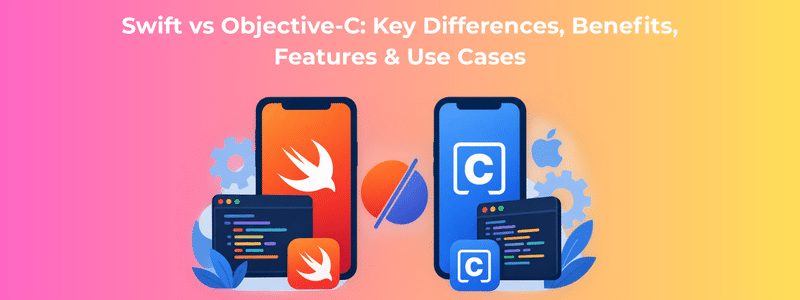
The iOS development ecosystem has evolved significantly over the years, but Swift and Objective-C remain two of the most important programming languages associated with Apple platforms. Objective-C powered generations of iPhone, iPad and Mac applications, while Swift was introduced by Apple as a modern alternative designed to make application development faster, safer and easier to maintain.
For businesses planning to build or modernise an iOS application, choosing between Swift and Objective-C can be an important technical decision. While Swift is now the preferred choice for most new iOS projects, Objective-C continues to have relevance in legacy applications, mature codebases and projects that depend on older libraries or frameworks.
Understanding the differences between Swift vs Objective-C can help developers, technology leaders and businesses select the right approach for their application requirements.
In this guide, we compare Swift and Objective-C based on syntax, performance, safety, development speed, memory management, interoperability, scalability, maintenance, features and use cases. We will also explore whether Objective-C is still relevant and why Swift has become the dominant language for modern iOS development.
What Is Swift?
Swift is a general-purpose programming language developed by Apple and introduced at WWDC in 2014. It was designed specifically to provide a modern, powerful and developer-friendly approach to building applications across Apple’s ecosystem.
Swift is commonly used for developing applications for:
- iPhone
- iPad
- Mac
- Apple Watch
- Apple TV
- Apple Vision Pro
- Server-side applications
Swift combines high performance with modern programming concepts. It supports object-oriented, protocol-oriented and functional programming approaches, giving developers flexibility when designing applications.
One of Swift’s major objectives is to reduce common programming errors while improving readability and development productivity. Features such as optionals, type safety, automatic reference counting and powerful error-handling mechanisms help developers create more reliable applications.
Swift has become Apple’s preferred language for new application development and is widely used throughout the modern Apple development ecosystem.
What Is Objective-C?
Objective-C is an object-oriented programming language that extends the C programming language with Smalltalk-inspired messaging capabilities. It became a foundational technology for Apple’s software ecosystem and was used extensively to build applications for Mac OS X and later iOS.
Objective-C was particularly important during the early growth of the iPhone and App Store ecosystem. Many established iOS applications were originally developed entirely or partially using Objective-C.
The language provides powerful features, including:
- Dynamic messaging
- Object-oriented programming
- Runtime introspection
- C and C++ interoperability
- Manual and automatic memory-management models
- Mature Apple framework support
Although Swift has become the preferred option for new development, Objective-C remains present in numerous enterprise and legacy applications.
Businesses with older iOS applications may therefore need developers who understand Objective-C, particularly when maintaining, upgrading or migrating existing codebases.
Swift vs Objective-C: Quick Comparison
Before exploring the differences in detail, here is a quick comparison of Swift and Objective-C.
| Factor | Swift | Objective-C |
|---|---|---|
| 導入 | 2014 | 1980s |
| 構文 | Modern and concise | Verbose |
| Learning curve | Generally easier | Generally steeper |
| パフォーマンス | High performance | High performance |
| Type safety | Strong type safety | Less strict |
| Memory management | Automatic Reference Counting | ARC available, legacy manual approaches exist |
| Error handling | Modern error-handling mechanisms | Traditional approaches |
| Development speed | Generally faster | Generally slower |
| 読みやすさ | 高い | More verbose |
| Apple ecosystem | Preferred for new development | Strong legacy support |
| C/C++ interoperability | サポート | 素晴らしい |
| Legacy applications | Suitable for new components | Widely used |
| New iOS projects | Recommended | Less commonly selected |
| 移住 | Can coexist with Objective-C | Can coexist with Swift |
The choice ultimately depends on the project’s requirements, existing codebase and long-term development strategy.
Key Differences Between Swift & Objective-C
1. Syntax and Code Readability
One of the most noticeable differences between Swift and Objective-C is syntax.
Objective-C inherits characteristics from C and Smalltalk, which can make code more verbose. Developers often need additional punctuation, method declarations and syntax structures to accomplish tasks that require fewer lines in Swift.
Swift was designed with simplicity and readability in mind. Its syntax is generally cleaner and more concise, making code easier to understand and maintain.
For example, a simple Swift declaration can be written in a compact format, while equivalent Objective-C code generally requires more syntax.
This difference can have a significant effect on development productivity, especially in large projects where developers constantly read, modify and review source code.
2. Ease of Learning
Swift is generally considered easier to learn than Objective-C, particularly for developers who are new to Apple application development.
Swift uses modern programming concepts and relatively straightforward syntax. Features such as type inference reduce unnecessary code, while optionals make potentially missing values more explicit.
Objective-C has a steeper learning curve because developers need to understand concepts associated with both C and Objective-C’s runtime and messaging model.
For organisations hiring new iOS developers or training development teams, Swift can therefore provide a more accessible starting point.
3. Type Safety
Swift places a strong emphasis on type safety.
Its compiler helps identify many programming errors during development rather than allowing them to surface unexpectedly at runtime. This can reduce bugs and improve application reliability.
Swift’s optional system is particularly useful for handling values that may or may not exist. Instead of silently working with a potentially null value, developers are encouraged to explicitly handle the possibility.
Objective-C offers considerably more flexibility, but historically its type system has been less strict. This flexibility can be useful in certain scenarios but can also result in runtime errors if developers do not carefully manage object types and null values.
4. Performance
Both Swift and Objective-C can deliver high-performance applications.
Objective-C has been used for decades in performance-sensitive Apple applications, and its mature compiler and runtime provide strong performance capabilities.
Swift was designed to deliver performance comparable to lower-level languages in many use cases while providing modern language features. Its compiled nature makes it suitable for demanding applications where performance matters.
In practical development, however, application performance depends on much more than the programming language. Factors such as algorithms, database operations, networking, memory usage, architecture and API implementation can have a greater effect on the final application.
Therefore, it would be inaccurate to assume that simply choosing Swift or Objective-C automatically determines application performance.
5. Memory Management
Memory management is another important consideration in the Swift vs Objective-C comparison.
Swift uses Automatic Reference Counting (ARC) to manage object lifetimes. Developers generally do not need to manually retain and release objects.
Objective-C also supports ARC, which significantly simplifies memory management compared with its older manual reference-counting model.
However, developers maintaining older Objective-C applications may encounter code written using manual memory-management techniques. Understanding these patterns can be essential when maintaining legacy applications.
Swift’s modern syntax and language design make memory-related programming easier to manage for many developers.
6. Error Handling
Swift provides a structured approach to error handling using mechanisms such as throw, try, catch そして throws.
This enables developers to explicitly define operations that can fail and handle those failures appropriately.
Objective-C traditionally relies on mechanisms such as error objects, return values and exceptions. While these approaches can be effective, they are generally less integrated into the language’s everyday syntax than Swift’s error-handling model.
Modern error handling can improve code clarity and make failure scenarios easier to understand.
7. Optionals
Optionals are one of Swift’s defining features.
An optional represents a value that may either contain a value or contain no value. Developers must explicitly account for that possibility.
This approach helps reduce unexpected null-related errors and encourages safer code.
Objective-C uses ゼロ for object references, but its traditional approach does not provide the same compile-time safety model as Swift optionals.
For applications that process large amounts of user input, network data or database information, Swift’s approach can help developers handle missing data more safely.
Features of Swift
Swift provides numerous features that make it suitable for modern iOS development.
Concise Syntax
Swift allows developers to express functionality using fewer lines of code compared with traditional Objective-C implementations.
Type Safety
Swift’s type system helps identify incompatible types and potential errors during compilation.
Optionals
Optionals provide an explicit mechanism for handling missing or unavailable values.
Automatic Reference Counting
ARC helps manage object memory automatically.
Generics
Generics allow developers to create reusable components that work with different types while maintaining type safety.
Closures
Swift provides powerful closure support, enabling developers to pass behaviour as values and build flexible application logic.
Protocol-Oriented Programming
Swift strongly supports protocols, enabling developers to design reusable and modular components.
Modern Error Handling
Swift’s structured error-handling model makes it easier to identify and manage recoverable failures.
Interoperability with Objective-C
Swift can work alongside Objective-C within the same application, making gradual migration possible.
Features of Objective-C
Objective-C continues to provide several capabilities that make it valuable for specific projects.
Dynamic Runtime
Objective-C’s dynamic runtime allows applications to perform certain operations dynamically at runtime.
Mature Apple Ecosystem
Objective-C has been used extensively across Apple’s platforms, creating a large ecosystem of established code and libraries.
C and C++ Compatibility
Objective-C’s relationship with C makes it particularly useful for projects that interact with C or C++ code.
Runtime Messaging
Objective-C uses a dynamic messaging system that provides considerable flexibility.
Legacy Code Support
Objective-C remains important for maintaining and extending older iOS applications.
Mature Framework Knowledge
Developers with extensive experience in Apple’s older frameworks may have significant expertise in Objective-C-based applications.
Swift vs Objective-C: Advantages of Swift
Swift offers several benefits for businesses and development teams.
開発の迅速化
Concise syntax can reduce the amount of code developers need to write and maintain.
Improved Code Safety
Strong typing and optionals help identify potential issues earlier in the development process.
Better Readability
Swift’s modern syntax makes code easier to understand for many developers.
Easier Maintenance
Cleaner code can simplify debugging, testing and long-term maintenance.
Modern Development Approach
Swift aligns closely with Apple’s current development direction and modern frameworks.
Strong Developer Adoption
Swift has become a major language for modern Apple-platform development, making it a natural choice for new iOS projects.
Swift vs Objective-C: Advantages of Objective-C
Despite Swift’s popularity, Objective-C still has important advantages in specific scenarios.
Mature Codebases
Many long-established applications contain substantial Objective-C code.
Legacy Frameworks
Some older libraries and frameworks may have been designed around Objective-C.
C and C++ Integration
Objective-C can be particularly useful for applications that depend heavily on existing C or C++ components.
Established Developer Expertise
Some organisations have development teams with extensive Objective-C experience.
Stable Existing Applications
If an Objective-C application is stable and continues to meet business requirements, rewriting the entire application may not provide sufficient return on investment.
Swift vs Objective-C: Which Is Better for iOS Development?
For most new iOS app development projects, Swift is generally the more suitable choice.
Its modern syntax, type safety, development experience and compatibility with Apple’s contemporary development ecosystem make it well suited to building new applications.
However, this does not mean Objective-C should automatically be removed from every project.
If a business owns a mature application with a large Objective-C codebase, completely rewriting the application in Swift could introduce unnecessary cost and technical risk.
A better strategy may be to gradually introduce Swift while retaining existing Objective-C components.
The right decision should therefore be based on:
- プロジェクト要件
- Existing technology stack
- Development team expertise
- Application age
- Third-party dependencies
- Migration requirements
- Maintenance costs
- Long-term product strategy
Swift vs Objective-C for New iOS Applications
When starting an iOS application from scratch, Swift is usually the stronger option.
A new project provides an opportunity to adopt modern language features from the beginning rather than inheriting technical debt from an older codebase.
Swift can help development teams build applications with:
- Modern architecture
- Stronger type safety
- Cleaner syntax
- Improved maintainability
- Modern Apple frameworks
- Easier onboarding for new developers
- Better support for contemporary development practices
For startups and businesses developing a new mobile product, these advantages can make Swift an attractive long-term investment.
Swift vs Objective-C for Legacy Applications
The decision becomes more complicated for legacy applications.
A mature Objective-C application may contain thousands or even millions of lines of tested code. Replacing everything with Swift may not be practical.
In these cases, developers can use Swift and Objective-C together.
A team can gradually migrate individual modules, services or features to Swift while maintaining the rest of the application in Objective-C.
This incremental approach can provide several benefits:
- Lower migration risk
- Reduced disruption
- Gradual modernisation
- Continued feature development
- Better control over development costs
- Opportunity to test new Swift components independently
Can Swift and Objective-C Work Together?
Yes. Swift and Objective-C can coexist within the same application.
This interoperability is one of the most important advantages for organisations maintaining existing iOS applications.
Developers can gradually introduce Swift into an Objective-C application rather than rewriting the entire project at once.
Similarly, existing Objective-C components can continue to operate while new functionality is developed using Swift.
This makes a hybrid development strategy practical for many enterprise applications.
Objective-C to Swift Migration: What Businesses Should Consider
Migrating an Objective-C application to Swift requires careful planning.
Before beginning migration, development teams should evaluate the existing codebase and identify components that are worth migrating.
Important considerations include:
Codebase Size
Large applications require a phased migration strategy rather than an immediate rewrite.
依存関係
Third-party libraries and internal frameworks should be evaluated for Swift compatibility.
Architecture
Poorly structured legacy applications may benefit from architectural improvements during migration.
テスト
Comprehensive automated tests can reduce the risk of introducing regressions.
Team Expertise
Developers should understand both Objective-C and Swift when working on a mixed codebase.
Business Priorities
Migration should support a clear business objective rather than being performed solely because Swift is newer.
When Should You Choose Swift?
Swift is generally a strong choice when:
- You are building a new iOS application.
- You want a modern codebase.
- Long-term maintainability is important.
- You need modern Apple framework support.
- You want strong compile-time safety.
- You are starting a new development team.
- You plan to continuously expand the application.
- You want to gradually replace an older Objective-C codebase.
For most modern mobile products, Swift should be the starting point unless there is a specific technical reason to use Objective-C.
When Should You Choose Objective-C?
Objective-C can still make sense when:
- You are maintaining an established Objective-C application.
- Your application relies heavily on existing Objective-C libraries.
- Your team has extensive Objective-C expertise.
- Your project depends on C or C++ integrations.
- Migration would introduce unnecessary technical or financial risk.
- Existing code is stable and does not require major modernisation.
The language may be older, but that does not mean every Objective-C application needs to be rewritten.
Swift vs Objective-C: Cost Considerations
Programming language selection can influence development costs, but the language itself is only one part of the overall budget.
Swift can potentially reduce development and maintenance effort because of its concise syntax and modern language features.
Objective-C development can become more expensive when organisations need specialists capable of maintaining complex legacy codebases.
However, rewriting an existing Objective-C application entirely in Swift can also be expensive.
Businesses should therefore compare:
Current maintenance cost + migration investment + expected future benefits
rather than assuming that moving to Swift will immediately reduce costs.
For a new application, choosing Swift from the beginning can help avoid future migration work.
Swift vs Objective-C: Security Considerations
Security is another important factor in mobile application development.
Swift’s strong typing and safer handling of optional values can help reduce certain categories of programming errors. Developers can also use modern Apple security frameworks and development practices alongside Swift.
However, security does not depend solely on the programming language.
Secure iOS applications require appropriate:
- 認証
- Authorisation
- Encryption
- Secure API communication
- Key management
- Data storage practices
- Dependency management
- Input validation
- Secure coding practices
Whether an application is written in Swift or Objective-C, security should be incorporated throughout the development lifecycle.
Swift vs Objective-C: Maintenance and Scalability
For new applications expected to grow over many years, maintainability is a critical consideration.
Swift’s modern syntax and strong type system can make large codebases easier to understand and evolve. Its support for modular programming and protocol-oriented approaches can also help teams build reusable components.
Objective-C can certainly support large applications, but maintaining older code can become more challenging when the codebase uses outdated patterns or depends on legacy libraries.
For organisations planning long-term product development, Swift generally offers a more future-oriented foundation for new projects.
Common Use Cases of Swift
Swift is commonly used for:
iOS Applications
Swift is widely used for modern iPhone and iPad applications.
macOS Applications
Developers can use Swift to create applications for Apple’s desktop ecosystem.
watchOS Applications
Swift is suitable for applications designed for Apple Watch.
tvOS Applications
Developers can use Swift to build applications and experiences for Apple TV.
Cross-Platform Apple Development
Swift can support development across multiple Apple platforms using shared concepts and frameworks.
Server-Side Development
Swift can also be used in server-side development, although its primary association remains Apple’s ecosystem.
Common Use Cases of Objective-C
Objective-C remains useful for:
Legacy iOS Applications
Many older iOS applications still contain significant Objective-C code.
macOS Legacy Applications
Long-established Mac applications may rely heavily on Objective-C.
Existing Enterprise Systems
Businesses may maintain Objective-C applications because rewriting them would be costly or risky.
C/C++ Integrated Projects
Objective-C can be useful where applications depend on established C or C++ components.
Gradual Modernisation
Objective-C can continue to serve as the foundation while teams introduce Swift incrementally.
Future of Swift and Objective-C
The future direction of Apple development strongly favours Swift for new projects.
Swift’s modern language design, ongoing evolution and integration with contemporary Apple technologies make it a natural choice for developers building new applications.
Objective-C, however, is unlikely to disappear immediately. Large organisations still operate applications containing substantial Objective-C code, and maintaining those applications requires knowledge of the language.
This means both languages can continue to coexist.
The likely development model for many businesses will be:
Swift for new development + Objective-C for legacy maintenance and gradual migration.
This approach allows organisations to modernise their technology stack without unnecessarily disrupting established applications.
Swift vs Objective-C: Which One Should Your Business Choose?
There is no universal answer that applies to every project.
If you are starting a new iOS application, Swift is generally the recommended choice because it provides modern syntax, strong type safety, excellent maintainability and alignment with Apple’s current development ecosystem.
If you already operate a successful Objective-C application, however, there may be no need for an immediate complete rewrite.
Instead, consider a structured migration strategy that introduces Swift gradually.
The best technology decision should take into account the application’s current architecture, business requirements, development resources and long-term roadmap.
Why Choose RailsCarma for iOS Application Development?
Choosing the right development partner is just as important as choosing the right programming language. An experienced mobile development team can help businesses evaluate their technology requirements and select an approach that balances performance, scalability, maintainability and development costs.
レールカーマ brings extensive software development expertise to businesses looking to create, modernise and scale digital products. Whether you are planning a new Swift-based iOS application or need support for an existing Objective-C codebase, the development approach should be aligned with your product goals.
Our development expertise can support businesses with:
- iOS application development
- Swift application development
- Objective-C application maintenance
- Objective-C to Swift migration
- Legacy application modernisation
- API and backend integration
- Mobile UI/UX implementation
- Application testing and quality assurance
- Application maintenance and support
- Custom software development
With the right technical strategy, businesses can take advantage of Swift’s modern capabilities while continuing to protect the value of existing Objective-C investments.
結論
について Swift vs Objective-C debate is less about identifying an absolute winner and more about selecting the right technology for a particular application.
Swift is the natural choice for most new iOS development projects because it offers concise syntax, strong type safety, modern programming features and excellent support for Apple’s contemporary development ecosystem.
Objective-C continues to have value, particularly for legacy applications, established enterprise codebases and projects that depend on mature Objective-C, C or C++ components.
For businesses building a new mobile product, Swift provides a modern foundation for long-term development. For organisations with an existing Objective-C application, gradual migration can offer a practical path towards modernisation without requiring an expensive full rewrite.
Ultimately, the right decision depends on your application architecture, technical requirements, existing codebase, development team and long-term business objectives. Working with an experienced iOS application development partner can help you evaluate these factors and build a technology strategy that supports sustainable growth.
よくある質問
Is Swift better than Objective-C?
For most new iOS applications, Swift is generally the preferred choice because of its modern syntax, type safety, maintainability and alignment with Apple’s current development ecosystem. Objective-C remains useful for legacy applications and existing codebases.
Is Objective-C still used?
Yes. Objective-C is still used in existing iOS and macOS applications, particularly legacy and enterprise codebases. Developers may also encounter Objective-C when working with older libraries, frameworks or C/C++ integrations.
Can Swift replace Objective-C?
Swift can replace Objective-C for many new development scenarios, but completely replacing Objective-C in an established application may not always be practical. Swift and Objective-C can coexist, allowing businesses to migrate applications gradually.
Which is easier to learn: Swift or Objective-C?
Swift is generally easier for new developers to learn because it uses modern, concise syntax and provides features designed to prevent common programming errors.
Is Swift faster than Objective-C?
Both languages can deliver high-performance applications. Real-world performance depends on the application’s architecture, algorithms, memory usage, networking, database operations and implementation quality rather than the language alone.
Should I migrate my Objective-C app to Swift?
Migration can be beneficial when an application requires ongoing development, modernisation or improved maintainability. However, businesses should evaluate the size of the codebase, dependencies, architecture, testing coverage and migration costs before deciding.
Can Swift and Objective-C be used in the same project?
Yes. Swift and Objective-C are interoperable, allowing development teams to introduce Swift into an existing Objective-C project or maintain Objective-C components while developing new features in Swift.
Which language is best for new iOS app development?
Swift is generally the preferred choice for new iOS application development because it provides modern language features, strong type safety, concise syntax and support for Apple’s contemporary development tools and frameworks.



 Japanese
  English
  German
  French
  Spanish
  Italian
  Swedish