
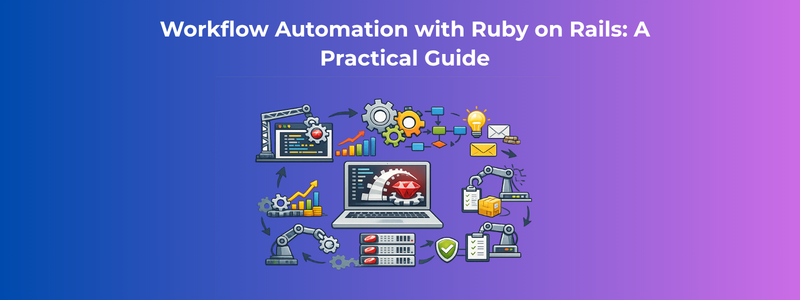
In today’s fast-paced digital landscape, businesses are constantly looking for ways to improve efficiency, reduce manual effort, and streamline repetitive tasks. Workflow automation has become an essential strategy for organizations seeking to increase productivity while minimizing operational costs. From customer onboarding and invoice processing to employee management and inventory tracking, automated workflows eliminate bottlenecks and ensure business processes run smoothly.
Among the many technologies available for developing workflow automation solutions, ルビー・オン・レイルズ(RoR) stands out as one of the most powerful and developer-friendly frameworks. Renowned for its convention-over-configuration philosophy, rapid development capabilities, and extensive ecosystem, Ruby on Rails enables businesses to build scalable workflow automation applications in less time without compromising quality.
Whether you’re a startup aiming to automate internal operations or an enterprise looking to modernize legacy systems, Ruby on Rails provides all the tools needed to create reliable, secure, and intelligent workflow automation platforms.
This practical guide explores workflow automation, why Ruby on Rails is an excellent choice, key features, implementation strategies, real-world use cases, and best practices for building automation solutions.
What is Workflow Automation?
Workflow automation refers to using software to execute business processes automatically based on predefined rules and conditions. Instead of relying on manual intervention, tasks are triggered automatically when specific events occur.
例えば:
- Automatically assigning support tickets to available agents
- Sending welcome emails after user registration
- Generating invoices after purchase completion
- Approving leave requests based on company policies
- Synchronizing data across multiple business applications
The primary goal is to reduce repetitive manual work while improving speed, consistency, and accuracy.
Why Businesses Need Workflow Automation
Organizations across industries face common operational challenges:
- Time-consuming manual processes
- Human errors in repetitive tasks
- Delayed approvals
- Poor communication between departments
- Inefficient data management
- Difficulty scaling operations
Workflow automation addresses these issues by:
- Accelerating business operations
- Improving collaboration
- Reducing operational costs
- Increasing employee productivity
- Enhancing customer experiences
- Ensuring process consistency
As businesses grow, automation becomes a necessity rather than a luxury.
Why Ruby on Rails is Ideal for Workflow Automation
Ruby on Rails has earned its reputation as one of the fastest frameworks for building business applications.
Here are the reasons why it excels in workflow automation.
1.迅速な開発
Ruby on Railsは コンフィギュレーションに関する条約(CoC) philosophy, allowing developers to focus on business logic rather than repetitive coding.
Pre-built conventions reduce development time significantly, making it easier to launch automation systems quickly.
2. MVC Architecture
Rails follows the Model-View-Controller architecture, ensuring:
- Organized codebase
- Better maintainability
- Easier debugging
- Scalable application design
This structure is particularly useful when workflows become increasingly complex.
3. Rich Ecosystem of Gems
Ruby on Rails offers thousands of open-source gems that simplify automation development.
Popular gems include:
- サイドキック
- 遅延したジョブ
- アクティブ・ジョブ
- 評論家
- 工夫する
- AASM
- ペーパートレイル
- いつでも
These tools eliminate the need to build common functionalities from scratch.
4. Excellent Database Support
Automation systems often involve handling large amounts of structured data.
Rails works seamlessly with:
- PostgreSQL
- MySQL
- SQLite
- MariaDB
Its Active Record ORM simplifies database interactions while maintaining excellent performance.
5. Easy API Integration
Modern workflow automation rarely operates in isolation.
Rails easily integrates with:
- CRMs
- 決済ゲートウェイ
- HR software
- ERPシステム
- Marketing platforms
- Accounting software
- Cloud services
Core Components of Workflow Automation in Ruby on Rails
Successful workflow automation applications typically include several essential components.
Business Rules Engine
Business rules determine how workflows behave.
例えば:
“If invoice amount exceeds ₹50,000, send approval request to Finance Manager.”
These rules can be dynamically configured for flexibility.
Background Job Processing
Not every task should run during user requests.
Rails supports asynchronous processing using:
- サイドキック
- アクティブ・ジョブ
- レスク
例としては、次のようなものがあります:
- メール通知
- レポートの作成
- Data imports
- File processing
- APIの同期
Background jobs improve user experience while reducing server response times.
通知
Workflow automation relies heavily on communication.
Rails can send:
- Emails
- SMS通知
- プッシュ通知
- Slack messages
- Microsoft Teams alerts
Real-time notifications keep stakeholders informed throughout every workflow stage.
ロールベースのアクセス制御
Automation systems involve multiple users with different responsibilities.
例:
- Employee
- マネージャー
- HR
- ファイナンス
- 管理者
Rails provides robust authentication and authorization frameworks to manage permissions securely.
監査ログ
Businesses often require complete visibility into automated actions.
Rails allows developers to record:
- Who approved requests
- When changes occurred
- Previous values
- Workflow history
Audit trails improve accountability and regulatory compliance.
Common Workflow Automation Use Cases
Ruby on Rails powers automation across numerous industries.
Customer Onboarding
Automated onboarding workflows can:
- Create user accounts
- Verify emails
- Assign account managers
- Schedule welcome emails
- Generate customer records
This creates a seamless onboarding experience.
人事業務の自動化
Human resource departments automate:
- Leave approvals
- 新入社員の受け入れ
- 給与計算のワークフロー
- Performance reviews
- 書類の確認
Automation reduces paperwork and administrative overhead.
Sales Pipeline Management
Sales teams automate:
- 主任担当
- Follow-up reminders
- Proposal generation
- CRM updates
- Sales reporting
This helps representatives focus on closing deals.
Invoice Processing
Finance teams automate:
- 請求書の作成
- Approval workflows
- Payment reminders
- Tax calculations
- 財務報告
Manual accounting tasks become significantly faster.
カスタマーサポート
Support systems automate:
- Ticket routing
- Escalation rules
- Auto responses
- SLA monitoring
- Feedback collection
Customers receive quicker responses while support teams work more efficiently.
在庫管理
Retail businesses automate:
- Stock monitoring
- 発注書
- Supplier notifications
- Low inventory alerts
- Warehouse synchronization
Automation minimizes stock shortages and overstock situations.
How Ruby on Rails Handles Complex Workflow Logic
Business processes often involve multiple approval levels and decision points.
Consider a procurement workflow:
Employee submits purchase request.
↓
Department Manager reviews.
↓
Finance verifies budget.
↓
Procurement approves vendor.
↓
Purchase order generated.
↓
Supplier notified.
↓
Inventory updated.
↓
Accounting records transaction.
Rails models can represent every stage while state machines manage transitions efficiently.
This structured approach simplifies even highly sophisticated workflows.
Integrating Third-Party Services
Workflow automation often depends on external applications.
Ruby on Rails integrates with:
Payment Platforms
- ストライプ
- カミソリペイ
- PayPal
CRM Systems
- セールスフォース
- HubSpot
- Zoho CRM
コミュニケーションツール
- Slack
- Microsoft Teams
- Twilio
Cloud Storage
- AWS S3
- Google Cloud Storage
- Azure Blob Storage
Email Platforms
- SendGrid
- Mailgun
- Amazon SES
API integrations allow workflows to span multiple business systems seamlessly.
Building an Automation Workflow in Ruby on Rails
A practical workflow automation project generally follows these steps.
Step 1: Understand Business Requirements
Identify:
- Existing workflow
- Manual bottlenecks
- Decision points
- Approval hierarchy
- Expected outcomes
Clear requirements reduce development revisions.
Step 2: Design Workflow
Create diagrams showing:
- Process flow
- User roles
- Trigger events
- Conditional logic
- 通知
Visual planning simplifies implementation.
Step 3: Build Database Models
Create models representing:
- Users
- Tasks
- Requests
- Workflow stages
- Activity logs
- 通知
Proper database design supports scalability.
Step 4: Implement Business Logic
Controllers and service objects execute:
- バリデーション
- 承認
- State transitions
- 通知
- API calls
Keeping business logic modular improves maintainability.
Step 5: Add Background Jobs
Move resource-intensive tasks into background processing.
例:
- Sending emails
- Generating reports
- Uploading files
- Synchronizing data
This keeps applications responsive.
Step 6: Test Everything
自動化システムには、徹底的なテストが必要です。.
Rails は以下をサポートしています:
- Unit tests
- Integration tests
- システムテスト
- API tests
Testing ensures workflows perform correctly under different scenarios.
セキュリティに関する考慮事項
Automation systems often process sensitive business information.
Ruby on Rails includes built-in protections against:
- SQLインジェクション
- クロスサイト・スクリプティング (XSS)
- クロスサイト・リクエスト・フォージェリ(CSRF)
- パラメータの改ざん
Developers should also implement:
- 多要素認証
- データの暗号化
- ロールベースの権限
- APIの認証のセキュリティ確保
- 監査ログ
Security should never be an afterthought.
Performance Optimization Tips
Large automation platforms process thousands of workflow events daily.
To maintain high performance:
- Optimize database queries
- Cache frequently accessed data
- Use background workers
- Index database tables
- Paginate large datasets
- Monitor server performance
- Optimize API calls
Rails offers excellent scalability when optimized correctly.
Best Practices for Workflow Automation with Ruby on Rails
Successful automation projects follow proven development practices.
Keep Business Logic Separate
Use service objects instead of placing complex logic inside controllers.
This improves readability and testing.
Make Workflows Configurable
Avoid hardcoding approval rules.
Allow administrators to modify workflows without changing application code.
Build Modular Components
Reusable modules simplify maintenance and future enhancements.
Log Every Important Action
Activity logs assist with:
- デバッグ
- Compliance
- 報告
- Auditing
Comprehensive logging increases system transparency.
失敗を潔く処理する
External APIs occasionally fail.
Implement:
- Retry mechanisms
- Error notifications
- Rollback procedures
- Exception monitoring
Reliable automation anticipates failures.
Monitor Workflow Performance
次のような指標を追跡します:
- Average completion time
- Failed jobs
- Queue length
- API response time
- Approval delays
Continuous monitoring improves operational efficiency.
Future of Workflow Automation with Ruby on Rails
Workflow automation is rapidly evolving through emerging technologies.
Future automation platforms increasingly incorporate:
- 人工知能
- 機械学習
- 予測分析
- ロボティック・プロセス・オートメーション(RPA)
- インテリジェントな文書処理
- Natural language processing
- Real-time analytics
Ruby on Rails integrates effectively with modern AI services and cloud platforms, making it well-suited for developing next-generation intelligent workflow solutions.
Businesses are moving beyond simple rule-based automation toward systems capable of making context-aware decisions, identifying process bottlenecks, and continuously improving operations. Rails provides the flexibility needed to build and scale these advanced automation ecosystems.
結論
Workflow automation has become a strategic investment for organizations seeking greater efficiency, improved accuracy, and scalable operations. By automating repetitive tasks and streamlining complex business processes, companies can reduce costs, enhance productivity, and deliver better experiences to both employees and customers.
Ruby on Rails remains one of the most effective frameworks for building workflow automation applications due to its rapid development capabilities, clean architecture, extensive ecosystem, robust security features, and seamless integration with third-party services. Whether automating HR processes, customer onboarding, financial approvals, inventory management, or enterprise-wide operations, Rails enables businesses to create reliable and scalable automation platforms with confidence.
For organizations looking to accelerate their digital transformation journey through intelligent workflow automation, レールカーマ offers deep expertise in Ruby on Rails development, helping businesses design, develop, and deploy customized automation solutions that drive long-term operational success.




 Japanese
  English
  German
  French
  Spanish
  Italian
  Swedish