
Key takeaways
- Python remains the overall popularity leader, driven almost entirely by AI, machine learning, and data science adoption, even as it cedes ground in large-scale backend systems.
- JavaScript and TypeScript still run the web. Nearly every interactive website depends on one or both, and TypeScript’s enterprise adoption keeps climbing as codebases grow more complex.
- Ruby on Rails remains one of the fastest paths from idea to production-grade product. Its convention-over-configuration philosophy and mature ecosystem make it a go-to choice for startups, SaaS platforms, and marketplaces that need to ship quickly without sacrificing maintainability.
- Performance-oriented languages like Rust and Go continue gaining ground in infrastructure, cloud-native tooling, and systems where every millisecond and megabyte counts.
- No single language wins everywhere. The right choice depends on your product stage, team size, hiring pool, and long-term scaling plans — which is exactly why this comparison matters.
Choosing the right programming language is one of the most important decisions involved in building a modern software product. The technology you select can influence development speed, application performance, scalability, security, hiring requirements, maintenance costs, and the ability to add new features as your business grows.
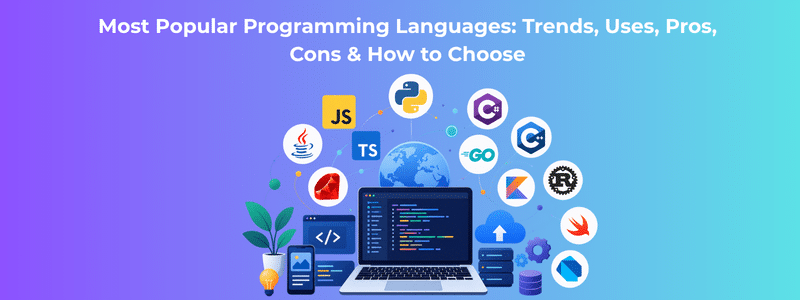
In 2026, developers have more programming languages and technology ecosystems to choose from than ever before. Python continues to dominate artificial intelligence, machine learning, automation, and data science. JavaScript and TypeScript remain central to web development, while Java and C# continue to power large enterprise systems. Go and Rust are gaining attention for performance-oriented and cloud-native workloads, while Kotlin, Swift, and Dart serve important roles in mobile development.
Ruby also continues to have a strong place in modern web application development, particularly through Ruby on Rails. Rails is known for its developer productivity, conventions, mature ecosystem, and ability to help teams turn product ideas into production applications efficiently.
But there is no universally “best” programming language.
The right choice depends on what you are building, your technical requirements, available talent, expected scale, development timeline, budget, and long-term product strategy.
This guide explores the 20 best programming languages in 2026, their primary use cases, advantages and limitations, and the types of projects they are best suited for.
What Is a Programming Language?
A programming language is a formal system used by developers to communicate instructions to computers. It provides syntax and rules that allow programmers to create software, process information, manipulate data, build applications, and interact with hardware and other systems.
Different programming languages are designed around different priorities.
For example, Python emphasizes readability and developer productivity. JavaScript is fundamental to interactive web experiences. C and C++ are widely associated with low-level and performance-intensive software. Rust focuses heavily on memory safety and performance. Ruby emphasizes developer productivity and expressive code.
Programming languages are also commonly paired with frameworks and libraries.
Till exempel:
- Ruby is commonly used with Ruby on Rails.
- Python is used with Django, Flask, and FastAPI.
- JavaScript is used with frameworks such as React, Angular, and Node.js-based ecosystems.
- C# is closely associated with the .NET ecosystem.
- Kotlin is widely used for Android development.
- Dart is the language behind Flutter.
The programming language is therefore only one component of a larger technology stack.
Top Programming Languages in 2026 at a Glance
| Rank | Programming Language | Best Known For | Vanliga användningsfall |
|---|---|---|---|
| 1 | Python | AI and data science | AI, ML, automation, backend |
| 2 | JavaScript | Web development | Frontend, backend, web apps |
| 3 | Java | Enterprise development | Enterprise software, backend, Android |
| 4 | C# | .NET development | Enterprise, cloud, games |
| 5 | C++ | High performance | Systems, gaming, embedded |
| 6 | TypeScript | Modern web development | Web apps, backend, enterprise |
| 7 | Go | Cloud-native development | APIs, microservices, infrastructure |
| 8 | Rubin | Product and web development | SaaS, web apps, APIs |
| 9 | Rust | Secure high-performance software | Systems, infrastructure, WebAssembly |
| 10 | PHP | Server-side web development | Websites, CMS, eCommerce |
| 11 | Kotlin | Modern JVM and Android development | Mobile, backend |
| 12 | Swift | Apple development | iOS, macOS, watchOS |
| 13 | Dart | Cross-platform development | Mobile and web applications |
| 14 | R | Statistical computing | Data science, statistics |
| 15 | Scala | JVM and data engineering | Big data, backend |
| 16 | SQL | Data management | Databases, analytics |
| 17 | MATLAB | Engineering and numerical computing | Research, simulations |
| 18 | Lua | Embedded scripting and games | Games, embedded systems |
| 19 | Perl | Scripting and text processing | Automation, legacy systems |
| 20 | Solidity | Blockchain-utveckling | Smart contracts, Web3 |
These rankings should be treated as a practical editorial comparison rather than an absolute hierarchy. Programming language popularity varies considerably depending on the industry, application type, developer community, and technology stack.
How We Selected the Top Programming Languages for 2026
There is no single metric that determines whether one programming language is better than another. A language that is excellent for machine learning may be a poor choice for operating-system development.
For this guide, programming languages are evaluated based on several practical factors:
Developer Adoption
A large developer community can make it easier to recruit engineers, find technical resources, troubleshoot problems, and maintain an application.
Ecosystem and Libraries
A mature ecosystem gives developers access to frameworks, libraries, integrations, testing tools, deployment solutions, and development resources.
Prestanda
Some applications require extremely high performance, while others prioritize development speed and maintainability.
Skalbarhet
Businesses should consider whether the language and its ecosystem can support an application as traffic, users, transactions, and data volumes increase.
säkerhet
Security features, community practices, libraries, frameworks, and available development tools all influence application security.
Development Speed
For startups and businesses working under tight deadlines, development productivity can be just as important as raw application performance.
Long-Term Maintainability
Software can remain in production for years. A technology should therefore be evaluated according to how easily teams can maintain, upgrade, test, and extend it.
Top programming languages in 2026
1. Python
Python remains one of the most versatile programming languages available in 2026.
Its straightforward syntax and extensive ecosystem have made it particularly popular for artificial intelligence, machine learning, data science, automation, scripting, backend development, and scientific computing.
Python’s strength is not necessarily that it is the fastest language for every workload. Instead, it provides an excellent balance between readability, development speed, ecosystem maturity, and versatility.
Common Python Use Cases
- Artificial intelligence
- Machine learning
- Data science
- Automation
- Backend development
- Scientific computing
- Data analysis
- Scripting
- APIs
- Prototyptillverkning
Advantages of Python
Python is relatively easy to learn and has a huge collection of libraries and frameworks. Developers can build prototypes quickly and access mature tools for AI and data processing.
Its extensive ecosystem is one of the primary reasons Python remains so influential.
Limitations of Python
Python may not be the ideal choice for every performance-intensive application. For certain workloads involving extremely low latency or resource constraints, languages such as C++, Rust, or Go may be more suitable.
Best For
Python is particularly suitable for companies developing AI solutions, data-driven applications, automation platforms, analytical systems, and backend services.
2. JavaScript
JavaScript remains fundamental to modern web development.
It enables developers to build interactive browser-based experiences and has expanded beyond the browser through server-side runtimes and broader application ecosystems.
JavaScript can be used for both frontend and backend development, making it possible for teams to build substantial parts of an application using a shared language.
Common JavaScript Use Cases
- Websites
- Web applications
- Frontend development
- Backend services
- APIs
- Real-time applications
- Progressive web applications
- Cross-platform applications
Fördelar
JavaScript has an enormous ecosystem, extensive browser support, and a large developer community.
It also works with a wide range of frameworks and libraries.
Begränsningar
The ecosystem evolves rapidly, which can create complexity around dependencies, tooling, frameworks, and architectural decisions.
Best For
JavaScript remains an excellent choice for modern web applications, especially when interactive user experiences are central to the product.
3. Java
Java has remained an important programming language for enterprise software for decades.
Its maturity, scalability, ecosystem, and extensive tooling make it suitable for large applications and organizations with complex technology requirements.
Common Java Use Cases
- Enterprise applications
- Backend systems
- Financial applications
- Large-scale APIs
- Cloud services
- Android development
- Distributed systems
Fördelar
Java offers strong tooling, mature frameworks, extensive enterprise adoption, and a large developer ecosystem.
Begränsningar
Compared with newer languages and frameworks, Java applications can sometimes involve more boilerplate and architectural complexity.
Best For
Java remains particularly relevant to large organizations building complex, long-lived enterprise systems.
4. C#
C# is Microsoft’s general-purpose programming language and a central part of the .NET ecosystem.
It is widely used for enterprise software, backend development, cloud applications, desktop software, and game development.
Common C# Use Cases
- Enterprise applications
- Cloud applications
- APIs
- Desktop applications
- Game development
- Business software
Fördelar
C# provides modern language features, strong tooling, and deep integration with the .NET ecosystem.
Begränsningar
Its strongest advantages are often found within Microsoft’s broader technology ecosystem, which may make other languages more attractive for certain cross-platform or specialized projects.
Best For
Businesses already invested in Microsoft technologies may find C# particularly attractive for enterprise application development.
5. C++
C++ remains one of the most important languages for high-performance computing.
It provides extensive control over memory and system resources, making it suitable for software where performance is critical.
Common C++ Use Cases
- Game engines
- Operating systems
- Embedded software
- Financial systems
- High-performance applications
- Robotics
- Graphics
- Systems programming
Fördelar
C++ provides exceptional performance and extensive control over hardware resources.
Begränsningar
It has a steeper learning curve than many modern application-development languages, and memory management can introduce additional complexity.
Best For
C++ is particularly appropriate when performance, resource efficiency, or low-level system access is a primary requirement.
6. TypeScript
TypeScript extends JavaScript by introducing static typing and additional development features.
It has become increasingly popular for large and complex web applications because type checking can help developers identify certain problems earlier in the development process.
Common TypeScript Use Cases
- Enterprise web applications
- Frontend applications
- Backend services
- APIs
- Full-stack applications
- Large JavaScript projects
Fördelar
TypeScript can make large codebases easier to understand and maintain.
Its compatibility with the JavaScript ecosystem also allows teams to access a huge collection of existing tools and libraries.
Begränsningar
TypeScript introduces an additional compilation and configuration layer that smaller projects may not need.
Best For
TypeScript is particularly valuable for teams building large-scale web applications where maintainability and developer tooling are important.
7. Go
Go, also known as Golang, was designed with simplicity, concurrency, and efficient software development in mind.
It has become popular for cloud infrastructure, APIs, microservices, and distributed systems.
Common Go Use Cases
- Cloud applications
- Microservices
- APIs
- Infrastructure tools
- DevOps
- Distributed systems
- Networking
Fördelar
Go has a relatively simple syntax and strong support for concurrent programming.
It can produce efficient compiled applications while keeping development relatively straightforward.
Begränsningar
Go intentionally keeps the language relatively small, which some developers may find restrictive compared with feature-rich languages.
Best For
Go is an excellent option for cloud-native services, infrastructure software, APIs, and distributed applications.
8. Ruby
Ruby deserves special attention because of its continued importance in web and product development.
Ruby is designed around developer productivity and expressive syntax. Rather than forcing developers to write large amounts of repetitive code, Ruby emphasizes readable and concise programming.
The language’s most influential ecosystem is Ruby on Rails, a full-stack web application framework that provides conventions and tools for building database-driven web applications.
RailsCarma has specialized in Ruby on Rails application development for many years and provides custom Rails development, consulting, product development, SaaS development, Rails upgrades, and related services.
Common Ruby Use Cases
- Web applications
- SaaS platforms
- Startup products
- MVP-utveckling
- APIs
- E-commerce platforms
- Business applications
- Internal tools
- Product platforms
Why Ruby Remains Relevant
One of Ruby’s biggest advantages is developer productivity.
Ruby on Rails provides conventions for common application requirements, including database interaction, routing, application structure, testing, and web development workflows.
This allows development teams to focus more on product functionality instead of repeatedly creating infrastructure from scratch.
RailsCarma’s custom Rails development services cover requirements analysis, prototyping, development, testing, deployment, and ongoing support.
Advantages of Ruby
- Highly readable syntax
- Strong developer productivity
- Ett moget ekosystem
- Excellent web framework ecosystem
- Well suited to product development
- Strong fit for SaaS applications
- Rapid application development
Limitations of Ruby
Ruby may not be the first choice for every workload.
For example, highly performance-sensitive systems, certain low-level applications, and specialized machine-learning workloads may benefit more from languages such as C++, Rust, Go, or Python.
Is Ruby Still Relevant in 2026?
Ja.
Ruby’s value is particularly clear when the goal is to develop and maintain sophisticated web applications efficiently.
Ruby on Rails also continues to provide a mature framework for companies that need to build, modernize, and scale web products.
RailsCarma states that it has built Ruby on Rails applications since 2008 and specializes in areas including SaaS development and Rails application migration and upgrades.
9. Rust
Rust has attracted significant attention for combining performance with strong memory-safety guarantees.
It is designed for situations where developers need low-level control without accepting some of the memory-management risks traditionally associated with systems programming.
Common Rust Use Cases
- Systems programming
- Infrastructure
- Cloud services
- Security-sensitive software
- Embedded systems
- WebAssembly
- Performance-intensive applications
Fördelar
Rust provides strong performance and a powerful approach to memory safety.
Begränsningar
The learning curve can be substantial, especially for developers coming from higher-level languages.
Best For
Rust is a strong option for teams building secure, efficient, performance-sensitive systems.
10. PHP
PHP remains one of the world’s most established server-side web programming languages.
Its large installed base and mature ecosystem make it an important part of web development.
Common PHP Use Cases
- Websites
- Content management systems
- E-handel
- Web applications
- APIs
- Server-side applications
Fördelar
PHP has a large ecosystem and is supported by numerous hosting environments and development tools.
Begränsningar
The ecosystem contains a mixture of modern and legacy practices, so development quality can vary significantly depending on architecture and implementation.
Best For
PHP remains a practical choice for many content-heavy websites, e-commerce systems, and server-side web applications.
11. Kotlin
Kotlin is a modern programming language that runs on the Java Virtual Machine and has become strongly associated with Android development.
It offers concise syntax and modern language features while maintaining compatibility with much of the Java ecosystem.
Common Kotlin Use Cases
- Android applications
- Backend services
- JVM applications
- Enterprise systems
- Multiplatform development
Fördelar
Kotlin reduces boilerplate and integrates well with Java-based systems.
Begränsningar
Its ecosystem is strongest around JVM and Android development.
Best For
Kotlin is an excellent option for modern Android applications and JVM-based backend systems.
12. Swift
Swift is Apple’s modern programming language for developing applications across its ecosystem.
Common Swift Use Cases
- iOS applications
- macOS applications
- watchOS applications
- tvOS applications
- Apple-platform software
Fördelar
Swift is designed for performance, safety, and modern application development.
Begränsningar
Its primary strength is Apple’s ecosystem, which makes it less suitable when broad platform independence is the main requirement.
Best For
Swift is the natural choice for many native Apple application development projects.
13. Dart
Dart is best known for its relationship with Flutter, Google’s cross-platform UI toolkit.
Flutter allows teams to create applications for multiple platforms using a shared development approach.
Common Dart Use Cases
- Mobile applications
- Cross-platform applications
- Web applications
- Desktop applications
Fördelar
Dart and Flutter can help development teams share substantial portions of application code across platforms.
Begränsningar
The technology is closely associated with the Flutter ecosystem.
Best For
Dart is particularly useful when a business wants cross-platform applications while maintaining a unified development approach.
14. R
R is a programming language designed primarily around statistics, data analysis, and visualization.
Common R Use Cases
- Statistical analysis
- Data science
- Research
- Data visualization
- Academic computing
Fördelar
R provides extensive statistical packages and visualization capabilities.
Begränsningar
It is less commonly used as a general-purpose application-development language.
Best For
R is particularly valuable to researchers, statisticians, and data professionals.
15. Scala
Scala combines object-oriented and functional programming approaches and runs on the Java Virtual Machine.
Common Scala Use Cases
- Big data
- Data engineering
- Distributed systems
- Backend development
- JVM applications
Fördelar
Scala can combine advanced programming concepts with the Java ecosystem.
Begränsningar
Its sophisticated language features can increase the learning curve.
Best For
Scala is particularly relevant to organizations working with JVM-based data-intensive systems.
16. SQL
SQL is different from many languages on this list because it is specifically designed for working with relational databases.
It remains fundamental to software development because modern applications depend heavily on persistent data.
Common SQL Use Cases
- Database queries
- Data analysis
- Rapportering
- Data management
- Business intelligence
Fördelar
SQL provides a standardized way to interact with relational databases.
Begränsningar
SQL alone is not a complete replacement for a general-purpose programming language.
Best For
Almost every organization that works with relational data needs SQL knowledge in some capacity.
17. MATLAB
MATLAB is widely used for numerical computing, engineering, simulations, and scientific research.
Vanliga användningsfall
- Engineering
- Numerical analysis
- Simulations
- Signal processing
- Research
- Mathematical modeling
Fördelar
MATLAB provides specialized tools for mathematical and engineering workflows.
Begränsningar
It is less suited to general-purpose web and commercial application development.
Best For
Engineering teams, researchers, universities, and organizations working on scientific computing.
18. Lua
Lua is a lightweight scripting language that has found applications in gaming, embedded systems, and software customization.
Vanliga användningsfall
- Game development
- Embedded systems
- Scripting
- Application customization
Fördelar
Lua is lightweight and relatively easy to embed into other applications.
Begränsningar
It has a smaller ecosystem than mainstream languages such as Python or JavaScript.
Best For
Specialized embedded scripting and gaming scenarios.
19. Perl
Perl has been used extensively for scripting, automation, text processing, system administration, and legacy applications.
Although newer languages have taken over many modern development scenarios, Perl continues to exist in established production environments.
Vanliga användningsfall
- Automation
- Text processing
- System administration
- Legacy applications
- Scripting
Best For
Organizations maintaining existing Perl systems and specialized scripting environments.
20. Solidity
Solidity is a programming language specifically associated with smart-contract development on blockchain platforms.
Vanliga användningsfall
- Smart contracts
- Decentralized applications
- Blockchain platforms
- Token systems
- Web3 applications
Fördelar
Solidity is purpose-built for a specialized development ecosystem.
Begränsningar
Its use is much narrower than general-purpose languages such as Python or JavaScript.
Best For
Teams building applications that depend on blockchain-based smart contracts.
Best Programming Languages by Use Case
The “best” programming language depends heavily on the problem being solved.
Best Programming Languages for Web Development
For modern web development, JavaScript and TypeScript remain central to frontend development.
Python, Ruby, PHP, Java, C#, and Go are also widely relevant to backend systems.
Ruby on Rails is particularly attractive for teams that want to build database-driven web products efficiently.
Best Programming Languages for AI and Machine Learning
Python remains the dominant choice for many AI and machine-learning workflows because of its extensive ecosystem and developer adoption.
Python is commonly used with machine-learning libraries, data-processing frameworks, and AI tooling.
Best Programming Languages for Enterprise Software
Java and C# remain strong enterprise options.
Organizations may also use Python, JavaScript/TypeScript, Go, Ruby, or C++ depending on the application requirements.
Best Programming Languages for SaaS Development
There is no single language required for SaaS development.
Ruby on Rails, Python, Java, JavaScript/TypeScript, Go, and C# can all be used to build SaaS platforms.
Ruby on Rails can be particularly appealing for SaaS companies that prioritize rapid product development, maintainability, and a mature web framework.
RailsCarma specifically offers SaaS application development as part of its Ruby on Rails services.
Best Programming Languages for Mobile Development
For native utveckling av mobilappar:
- Swift is commonly used for Apple platforms.
- Kotlin is widely used for Android.
- Dart is commonly associated with Flutter cross-platform development.
Backend services for mobile applications can be developed using virtually any major backend technology.
Best Programming Languages for High-Performance Software
C++, Rust, and Go are strong candidates for applications where performance and resource efficiency are major considerations.
The correct choice depends on the specific workload and engineering requirements.
Ruby vs Python: Which Is Better?
Ruby and Python are often compared because both emphasize readable syntax and developer productivity.
However, they have different areas of strength.
| Factor | Ruby / Ruby on Rails | Python |
| Web development | Utmärkt | Utmärkt |
| SaaS development | Utmärkt | Utmärkt |
| MVP-utveckling | Utmärkt | Utmärkt |
| AI and ML | Limited compared with Python | Utmärkt |
| Data science | Limited compared with Python | Utmärkt |
| Developer productivity | Utmärkt | Utmärkt |
| Web framework ecosystem | Strong | Strong |
| Startup product development | Utmärkt | Utmärkt |
| Scientific computing | Limited | Utmärkt |
| Mature web applications | Utmärkt | Utmärkt |
If the primary goal is AI, machine learning, or scientific computing, Python is generally the stronger choice.
If the main objective is building a sophisticated web product or SaaS platform efficiently, Ruby on Rails can be an excellent option.
The decision should therefore be based on the product rather than language popularity alone.
Ruby vs JavaScript: Which Should You Choose?
Ruby and JavaScript serve different roles, although modern full-stack development can involve both.
JavaScript and TypeScript dominate browser-based application development.
Ruby, particularly through Rails, is often used to build the backend and complete web application architecture.
A modern product could even use both:
Frontend: JavaScript or TypeScript
Backend: Ruby on Rails
Database: PostgreSQL
Infrastructure: Cloud platform and containerized services
The best architecture depends on product requirements, team capabilities, performance needs, and integration requirements.
Also Read:
- Ruby on Rails vs Django: Vilket är rätt för dig?
- Ruby vs Golang: Which Language to Use in 2026?
- Ruby on Rails vs PHP
- Ruby on Rails kontra Laravel: Vilket är bäst år 2026?
Is Ruby on Rails Still Relevant in 2026?
Yes, particularly for web applications, SaaS products, business platforms, APIs, and product development.
The value of Ruby on Rails is not based on being the newest technology. Its strength comes from a mature framework, conventions, productivity, ecosystem, and long-term use in web application development.
RailsCarma has specialized in Ruby on Rails development for years and offers services covering custom application development, consulting, product development, SaaS applications, upgrades, cloud migration, and application support.
RailsCarma also describes its product development approach as covering business analysis, architecture, development, testing, deployment, monitoring, upgrades, and ongoing maintenance.
For businesses with an existing Rails application, the question is often not whether to replace Rails but how to modernize, optimize, secure, and scale the application.
What Should Businesses Consider Before Choosing a Programming Language?
Selecting a programming language should start with the business requirements rather than the technology itself.
1. Define the Product
Start by determining what you are building.
Is it:
- A SaaS platform?
- An e-commerce application?
- An internal business system?
- An AI platform?
- A mobile application?
- A marketplace?
- An API?
- A data platform?
The answer immediately narrows the technology options.
2. Consider Development Speed
If you need to validate an idea quickly, a productive framework can be more valuable than optimizing for theoretical maximum performance.
This is one reason frameworks such as Ruby on Rails remain attractive for startups and product teams.
3. Evaluate Scalability
Consider future traffic, users, data volumes, integrations, and geographical expansion.
Scalability is not solely determined by the programming language. Architecture, databases, caching, infrastructure, code quality, and engineering practices can all have a major impact.
4. Think About Hiring
A technically excellent language can still create challenges if qualified developers are difficult to find.
Consider the size and availability of the developer ecosystem before committing to a technology.
5. Consider Security
Security should be incorporated into the architecture and development lifecycle rather than treated as an afterthought.
Evaluate framework maturity, security tooling, dependency management, testing practices, and the team’s experience.
6. Evaluate Maintenance
A software product may exist for many years.
Before choosing a language, consider:
- Framework upgrade paths
- Documentation
- Developer availability
- Testing ecosystem
- Community support
- Third-party libraries
- Long-term maintenance requirements
7. Consider Total Cost of Ownership
Development cost is only one part of the equation.
Businesses should also consider:
- Infrastructure
- Hiring
- Underhåll
- Upgrades
- säkerhet
- Monitoring
- Testning
- Technical debt
- Future feature development
A language that allows a team to develop and maintain software efficiently can reduce total ownership costs over time.
Programming Language Trends to Watch in 2026
The programming landscape continues to evolve, but several major trends are shaping technology decisions.
AI-Assisted Development
AI coding tools are changing how developers write, test, document, and maintain software.
This does not eliminate the importance of programming languages. Instead, it increases the value of developers who understand architecture, security, system design, debugging, and business requirements.
Stronger Type Safety
TypeScript and languages such as Rust continue to demonstrate the value of stronger compile-time checks for large and complex software systems.
Cloud-Native Development
Go, Java, C#, Python, JavaScript/TypeScript, and other languages continue to play important roles in cloud environments.
Cloud architecture has also shifted the conversation from simply selecting a language to designing systems around containers, APIs, managed services, observability, and distributed infrastructure.
Continued Growth of AI and Data Applications
Python remains exceptionally important because of its role in AI, machine learning, analytics, and data science.
Modernization of Legacy Applications
Businesses are increasingly looking for ways to modernize existing applications without unnecessarily rebuilding everything from scratch.
Modernization may involve:
- Upgrading frameworks
- Refactoring legacy code
- Introducing APIs
- Improving testing
- Migrating infrastructure
- Adding cloud services
- Integrating AI
- Improving application performance
For organizations already using Ruby on Rails, upgrading and modernizing the existing application may be more practical than replacing the entire technology stack.
RailsCarma offers Rails consulting and upgrade services aimed at improving existing Rails applications, implementing new functionality, addressing technical issues, and upgrading applications to newer Rails versions.
How RailsCarma Helps Businesses Build Software
Choosing a programming language is only the beginning of a software project.
The development partner you select can have an equally important effect on the final outcome.
RailsCarma focuses heavily on Ruby on Rails development and provides services including custom Rails application development, Rails consulting, product development, SaaS development, mobile development, cloud migration, DevOps, and application maintenance.
Its custom application development process includes business analysis, requirements gathering, wireframing, prototyping, design and development, testing, deployment, and ongoing support.
For businesses looking to build a new product, this type of end-to-end approach can help connect technical decisions with business objectives.
RailsCarma also offers dedicated Ruby on Rails developers for organizations that need additional development capacity or specialized Rails expertise.
Slutsats
The programming language landscape in 2026 is more diverse than ever.
Python is exceptionally strong in AI and data science. JavaScript and TypeScript remain essential to web development. Java and C# continue to serve enterprise environments. C++ and Rust address performance-intensive workloads, while Go is increasingly relevant to cloud-native infrastructure.
Ruby and Ruby on Rails continue to occupy an important position in web application and product development.
The key lesson is that there is no universally best programming language.
The right technology depends on your business goals, application type, development timeline, team expertise, performance requirements, scalability expectations, security needs, and long-term maintenance strategy.
For businesses building web applications, SaaS platforms, APIs, marketplaces, and digital products, Ruby on Rails can remain a highly productive and practical technology choice in 2026.
RailsCarma brings a long-standing focus on Ruby on Rails utveckling, including custom applications, produktutveckling, SaaS solutions, Ruby on Rails konsultverksamhet, Rails upgrades, Hire Ruby on Rails developers, and ongoing application support.
Ultimately, successful software is not created simply by choosing a popular programming language. It comes from selecting the right technology for the problem, designing a scalable architecture, writing maintainable code, and continuously improving the product as business requirements evolve.
Vanliga frågor
What is the most popular programming language in 2026?
There is no single programming language that dominates every category. Python is particularly prominent in AI, machine learning, automation, and data science, while JavaScript and TypeScript remain central to web development.
Which programming language is best for beginners?
Python is often a good starting point because its syntax is relatively straightforward and its ecosystem is broad.
However, beginners should choose a language based on what they want to build.
Which programming language is best for web development?
JavaScript and TypeScript are essential technologies for modern frontend development. On the backend, Ruby, Python, Java, C#, Go, PHP, and JavaScript-based technologies can all be appropriate.
Is Ruby still used in 2026?
Yes. Ruby continues to be used for web applications, SaaS platforms, APIs, business applications, and product development. Ruby on Rails remains an important web application framework.
Is Ruby on Rails good for SaaS development?
Yes. Ruby on Rails is well suited to SaaS development because it provides conventions and tools that can help teams develop database-driven web applications efficiently.
Is Ruby better than Python?
Neither is universally better.
Python is generally stronger for AI, machine learning, data science, and scientific computing. Ruby on Rails is particularly strong for web application and product development.
Which programming language is best for startups?
There is no universal answer. Startups often benefit from languages and frameworks that allow teams to validate ideas quickly and maintain products efficiently.
Ruby on Rails, Python, JavaScript/TypeScript, and other productive ecosystems can all be strong choices depending on the product.
Which programming language is best for AI?
Python is generally the leading choice for AI and machine learning because of its extensive ecosystem and tooling.
Which programming language is best for enterprise software?
Java and C# remain strong enterprise choices, although large organizations also use Python, JavaScript/TypeScript, Go, C++, and Ruby depending on their systems.
Should businesses choose the newest programming language?
Not necessarily.
The newest technology is not automatically the best technology. Businesses should consider ecosystem maturity, developer availability, security, maintainability, performance, integration requirements, and long-term costs


 Swedish
  English
  Japanese
  German
  French
  Spanish
  Italian