
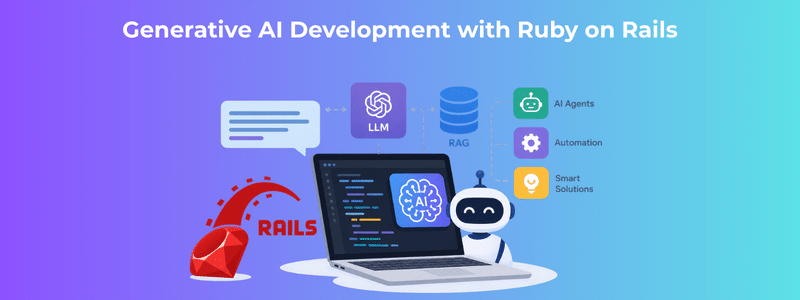
Generative AI is transforming the way companies create digital products, automate workflows, engage with customers, and process information. Organisations are seeking practical ways to integrate generative AI into their applications, including AI chatbots, content generation, intelligent document processing, and personalised recommendations. The combination of IA générative and Ruby on Rails would provide a flexible foundation for companies already using Ruby on Rails or looking to build their next web application with the framework to create intelligent, scalable and user-friendly applications.
Ruby on Rails has a long history of high productivity, convention over configuration, a mature ecosystem, and the ability to support complex web applications. Generative AI provides another layer of intelligence to applications to understand natural language, generate content, summarise information, answer questions, analyse documents and automate tasks. These technologies allow businesses to build applications that are not confined to conventional rule-based functionality.
What is generative AI?
Generative AI is a form of artificial intelligence that can create new content from data that already exists. Generative AI models can create human-like text, images, code, audio and other content, unlike traditional software that runs on pre-defined instructions.
Large language models, or LLMs, are really only reasonable for web applications. They can understand the user’s commands and generate responses accordingly based on the instructions and context provided. Companies can integrate these models into their applications and use them for a variety of tasks via APIs.
For example, a Ruby on Rails app can work with an AI model to build a smart customer support assistant. The assistant can understand natural language questions and respond with appropriate answers based on the information available, instead of matching keywords to pre-programmed responses.
Why combine generative AI with Ruby on Rails?
The brain is the generative AI. Application infrastructure is based on Ruby on Rails. Rails can be used for authentication, authorisation, database, APIs, background processing, business logic, user interface, etc. Ai model can do language intensive tasks.
“This separation allows developers to create AI-powered applications without needing to create a language model from scratch.” The Rails app talks to the external AI service using APIs, and can plug the generated output into existing workflows.
This combo can be particularly useful for companies with existing Rails apps that want to add AI features without having to start from scratch.
Top ruby on rails generative ai use cases
Many Rails apps can have generative AI baked right into them. The right use case is determined by the industry and data, business processes and customer requirements of the organization.
AI Customer Support
One of the most common uses is smart customer support. You can develop a rails app that provides a conversational interface to customers for asking about your products, services, orders, policies, or account information.
The Rails backend does the user authentication, fetches the required account details, provides the appropriate context to the AI model, and returns the AI generated response. If the question is more complex, the system can hand over the dialogue to a human support agent.
This allows organisations to react faster, but also reduces the workload from repetitive customer requests.
Content Generation
Generative artificial intelligence helps companies create product descriptions, blog outlines, marketing copy, email drafts, social media content, and internal documentation.
A Rails-based content management platform can provide an interface for employees to add a topic or a short and request content created by AI. The application can then allow the users to review, edit, approve and publish the generated material.
Human review still has an important part to play when accuracy, reputation for the brand or regulatory requirements are at stake.
Search AI
Keyword based search is often not working well when the user asks a question in a different way of the language of a database. Applications may utilise semantic search and generative artificial intelligence to help discover the intent of a query.
For example, rather than searching for a particular product name, the user may ask, “Show me lightweight laptops that are good for frequent business travel.” An AI-powered Rails application would be able to interpret the request and find products that match the relevant attributes.
Document Analysis
Contracts, reports, manuals, invoices, policies and other documents fill the business world. Generative AI is able to provide summaries of documents, pull out relevant information, answer questions and categorise content.
Build a secure document-upload feature with a Rails app, and process documents with background jobs. The information captured can then be saved or sent to an AI model for analysis.
AI Coding Assistants
Generative artificial intelligence may also be integrated into software development platforms built on Rails. The apps may offer features such as code snippet generation, code explanation, bug detection, or documentation generation.
For large development teams in organisations, AI-assisted development can increase productivity but developers are still responsible for reviewing and validating the generated code.
Rails + AI APIs
Using an API from an AI provider is one of the most pragmatic ways to add generative AI capabilities to a Rails app. Rails backend gets a generated response and a well-formed request.
Developers have to consider authentication, API keys, request validation, error handling, timeouts, rate limits, response parsing and cost management.
Never expose your AI API credentials in client-side code. They should be stored in a good way with good server-side configuration and secret-management practices.
AI Background Jobs Processing
Some AI operations may take longer than normal web requests, particularly when applications are working on large documents or multiple AI requests.
Ruby on Rails applications can use background job systems to process these tasks asynchronously. Instead of waiting for a long running operation to finish, the application can schedule a task with a background worker and inform the user when the processing is done.
Generative AI and databases
Much AI application needs to access business data. Rails already has a great database integration with Active Record so it should be able to extract relevant information and pass it to AI platforms where it makes sense.
An ecommerce app, for instance, can retrieve product details, order info, and consumer preferences before responding.
However, developers need to be very careful when exposing data to artificial intelligence (AI) systems. Application level authorisation should be enforced so there are no ways for users to access information they are not entitled to.
Rails for Retrieval-Augmented Generation
Retrieval-Augmented Generation (RAG) can be particularly helpful for applications that operate on private or frequently updated business data.
In a RAG architecture business information is stored in a knowledge base that can be searched. The user poses a question. The system retrieves relevant information and feeds it to the AI model as context.
For example, an employee portal built on Rails could have the company policies and other internal docs. If an employee asks a question about a particular policy, the application can pull out the content of the policy document and feed it into the AI model to get an answer.
This can be more pragmatic than trying to encode all the changing business information directly into a model.
Prompt Engineering for Ruby on Rails Applications
The quality of generative AI output depends largely on the structure of requests. What is prompt engineering? It’s about designing instructions and context that steer the model toward useful results.
Dealing with AI Hallucinations
One of the big problems with generative AI is hallucination, where the model generates information that sounds plausible but that isn’t.
No business should assume AI-generated responses are correct by default. Applications need to have good controls in place to protect valuable information.
These include providing dependable context via RAG, validating structured outputs, restricting responses to approved information, displaying appropriate disclaimers and introducing human review for high-risk workflows.
The amount of oversight required depends on what the application is for and what the consequences are if the information is wrong.
Security problems
Security is especially important when integrating generative AI into business applications.
Rails developers have to consider authentication, authorisation, encryption, secure API credentials, input validation, logging, access control and prompt injection mitigations.
Applications should also be careful not to send sensitive information to external AI vendors unless necessary. Data should be minimised and processed in line with the organisation’s privacy and security requirements.
AI integrations should be viewed as part of the application’s security architecture, not as a feature itself.
How to defend against prompt injection
Prompt injection is a security attack in which malicious or unanticipated instructions are embedded into user input or retrieved data to influence the operation of an AI system.
For example, if an AI assistant is drawing information from user generated documents, malicious text in a document might theoretically try to override system instructions.
They can also separate trusted instructions from untrusted content, restrict AI permissions, verify tool calls, control available actions and require confirmation for sensitive operations.
Testing generative AI applications
Testing an AI-Powered Rails App: More Than Unit and Integration Tests AI responses may vary and should be evaluated in representative situations.
Tests could include:
- Testing of functions
- Test prompt
- Accuracy Evaluation
- Security penetration testing
- Performance Test
- Load testing
- Regression test
- Output validation
Define a set of representative prompts and expected behaviour to allow teams to evaluate changes to models, prompts, retrieval systems or application logic in a consistent way.
Monitoring of AI performance
Once an AI feature has been deployed, you need to monitor it. Among other things, companies should monitor response time, API failures, token consumption, user feedback, error rates and application performance.
For RAG systems, teams can also monitor the quality of retrieval and relevance of the retrieved context to user queries.
Regular check-ins can help developers identify issues and improve the AI experience over time.
Generative AI Cost Control
There can be additional operating costs of AI usage. Costs can vary based on chosen model, request volume, input/output sizes, document handling, embeddings, and infrastructure.
Rails apps can cache the results of common requests, reducing the number of unnecessary requests; choose the right models for the task; and perform non-urgent operations asynchronously.
And developers should track AI usage so that businesses can understand the cost of the individual features and workflows.
Enhancing the customer experience
“Just putting AI in an app doesn’t necessarily improve the experience for users. The AI capabilities should respond to actual user needs and work seamlessly in existing workflows.
A good AI interface will help users understand they are interacting with AI, give useful feedback while processing requests, handle errors gracefully, and provide ways to correct or improve results.
Instead of just putting a generic chatbot into an app because chatbots are all the rage, businesses need to find specific customer problems that conversational AI is good at solving.
Scaling Rails Apps Powered by AI
With increased usage, the AI features may become a core part of application infrastructure. Scaling is about request volume, background jobs, database performance, caching, API limits and monitoring.
Rails applications can take advantage of common scaling methods such as horizontal app scaling, background processing, caching, database optimisation, and asynchronous workflows.
AI-specific considerations need to be designed into the overall architecture from the beginning, not as an afterthought when performance problems occur.
Ruby on Rails Generative AI Development Guidelines
Businesses and development teams should begin with a well-defined business problem, not by choosing AI because it is a hot technology. The use case chosen should have measurable objectives and well-defined success criteria.
Rather, developers should select AI models according to the real requirements of the application, taking into account accuracy, latency, cost, privacy, and functionality. Controls of access and good data-handling practices are required to protect sensitive data.
When accuracy is important, AI outputs should be checked, and decisions with risks should be appropriately supervised by humans. Design your applications to be observable, so teams can see how they are doing, how much they are costing, what errors they are seeing, and what users are saying.
Finally, artificial intelligence systems need to be seen as evolving components. Models, APIs, security practices, user expectation and business requirements can change over time. Thus, continuous maintenance is needed.
Why Choose RailsCarma for Generative AI Development Services?
RailsCarma enables companies to combine the agility of Ruby on Rails with the advanced capabilities of generative AI. An experienced development team can help to build AI-driven web applications, API Integrations, Intelligent Automation, RAG based systems, AI assistants, custom workflows and modernising existing Applications Rails.
The right way to develop starts with understanding the business goal, the current application architecture, the data you have available, the security requirements and the way you want the user to experience the app. That’s where you can add AI capabilities to the Rails app in a way that is both scalable and maintainable over time.
Conclusion
Generative AI and Ruby on Rails is a potent combo to build modern intelligent applications. Rails provides the foundation for authentication, business logic, databases, APIs, integrations and application management; and generative AI enables natural-language interaction, smart automation, content creation, document analysis and other advanced features.
It’s not just about successfully plugging an AI API into a Rails app and making it work. Business needs to consider architecture, data management, security, prompt engineering, retrieval, testing, monitoring, cost and user experience. They also need to figure out how AI provides real value, not just add AI features for no good reason.
Ruby on Rails apps can use generative AI effectively if they choose the right development strategy, without sacrificing the framework’s productivity, maintainability and scalability strengths. The combination can provide a pragmatic foundation for organisations looking to build new or upgrade existing Rails products, with intelligent digital experiences and automation solutions. To know more connect with RailsCarma.


 French
  English
  Japanese
  German
  Spanish
  Italian
  Swedish