
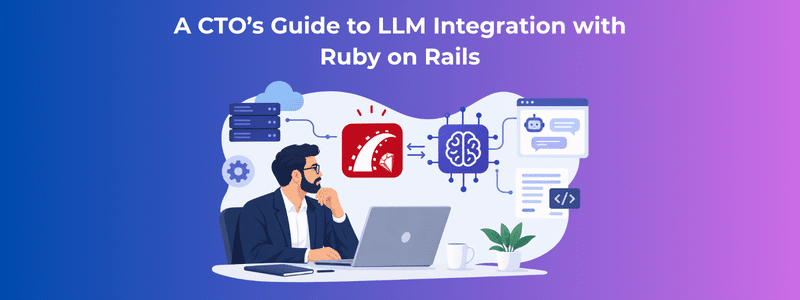
Large Language Models (LLMs) are transforming how businesses build software, automate operations, interact with customers and deliver digital products. From intelligent customer support and document analysis to AI-powered search, content generation, coding assistants and workflow automation, LLMs are becoming an important component of modern enterprise applications. For companies already using Ruby on Rails, it’s a way to add LLM capabilities to existing applications, injecting intelligence into those apps without needing to replace the underlying tech stack.
But successful LLM integration is more than hooking an AI API to a Rails application. Technology leaders need to think about architecture, security, data privacy, model selection, scalability, performance, costs, monitoring, user experience and long-term maintainability. The central question for a CTO is not only if an LLM can be integrated with Rails, but how to do it responsibly and strategically to create real business value.
This guide covers the key things CTOs need to know when they plan to integrate LLMs with Ruby On Rails apps.
What Is an LLM?
A Large Language Model is an AI system trained on massive amounts of data in order to understand and generate human-like language. LLMs can perform full tasks such as question answering, summarisation, content generation, data extraction, translation, classification and software development assistance.
Modern LLMs are accessible via APIs, which allow applications to send prompts and contextual information and get generated responses back. This allows a Ruby on Rails application to leverage LLM capabilities without the need to host or train a large language model from scratch.
For example, a customer portal built in Rails could let users ask questions in natural language. The Rails backend can handle the request, get the necessary customer information, send the right context to an LLM, and return the generated response.
Why Integrate LLMs With Ruby on Rails?
Ruby on Rails is a mature web application development framework. Provides conventions for routing, database management, authentication, background processing, APIs, and application architecture. LLMs can add natural-language intelligence on top of these abilities.
Instead of rebuilding an existing Rails application from scratch, organisations can enhance it with LLMs. AI capabilities can be embedded in specific workflows where they add real value.
Such benefits could include higher employee productivity, automation of repetitive tasks, faster customer support, intelligent information retrieval, better content workflows, and new product capabilities.
Common LLM Use Cases for Rails Applications
Before selecting an LLM architecture, CTOs should identify specific business problems that AI can solve.
AI-Powered Customer Support
An LLM can power conversational customer-support experiences capable of understanding natural-language questions. A Rails backend can retrieve account information, order details, product information, or support documentation before providing relevant context to the model.
The system can also escalate complex or sensitive questions to human agents.
Intelligent Search
Traditional keyword search requires users to enter terms that closely match stored information. LLM-powered or semantic search can understand the intent behind a query and help users discover relevant information.
This can be useful for knowledge bases, ecommerce catalogs, internal documentation, and customer portals.
Document Summarization
Businesses often work with lengthy reports, contracts, policies, and technical documents. LLMs can summarize these documents and extract relevant information.
A Rails application can provide secure document uploads and process them asynchronously using background jobs.
Content Generation
LLMs can assist with generating product descriptions, marketing content, reports, email drafts, documentation, and other business material.
A Rails-based content platform can provide users with AI-assisted workflows while retaining human approval and editing capabilities.
Data Extraction and Classification
LLMs can convert unstructured information into structured data. For example, a business application can analyze customer messages and classify them according to topic, priority, or department.
This can reduce manual processing and improve workflow automation.
LLM Integration Architecture
A typical Rails and LLM architecture consists of several layers.
The user interacts with the Rails frontend. The request reaches the Rails backend, where authentication, authorization, validation, and business logic are applied. The application then retrieves any necessary information and communicates with an LLM provider through an API.
A simplified workflow is:
User → Rails Application → Business Logic → Context Retrieval → LLM → Response Processing → User
For advanced applications, additional components may include vector databases, caching layers, background job processors, monitoring systems, document-processing services, and external business APIs.
The architecture should be designed according to the application’s requirements rather than assuming that every LLM use case requires the same infrastructure.
Choosing the Right LLM
One of the most important decisions for a CTO is model selection. The most powerful model is not always the best choice.
Evaluation criteria should include:
- Précision
- Response quality
- Latence
- Coût
- Context capacity
- Privacy requirements
- Availability
- Structured output support
- Integration requirements
- Évolutivité
A simple customer-support classification task may not require the same model as a complex reasoning workflow. Using smaller or more cost-efficient models where appropriate can help control operational expenses.
CTOs should evaluate models against realistic business scenarios instead of relying exclusively on benchmark results.
API-Based LLM Integration
For many Rails applications, API-based integration is the most practical approach. The application communicates with an external LLM provider through authenticated API requests.
The Rails backend should manage API credentials securely and should never expose sensitive keys in client-side code.
The integration layer should also handle:
- Request validation
- Authentification
- Timeouts
- Retries
- Rate limits
- API errors
- Response parsing
- Exploitation forestière
- Usage monitoring
Creating a dedicated service layer for AI integrations can make it easier to change models or providers later without modifying business logic throughout the application.
Prompt Engineering
LLMs respond based on instructions and context provided to them. Prompt engineering involves designing those instructions carefully.
A production Rails application may use prompts containing system-level instructions, user input, business context, retrieved documents, formatting requirements, and safety rules.
For example, an enterprise support assistant could be instructed to answer only using approved documentation and to avoid inventing information when an answer cannot be found.
Prompts should be version-controlled and tested like other application logic. Changes to prompts can significantly affect model behavior, so production systems should have a structured approach to testing and deployment.
Retrieval-Augmented Generation
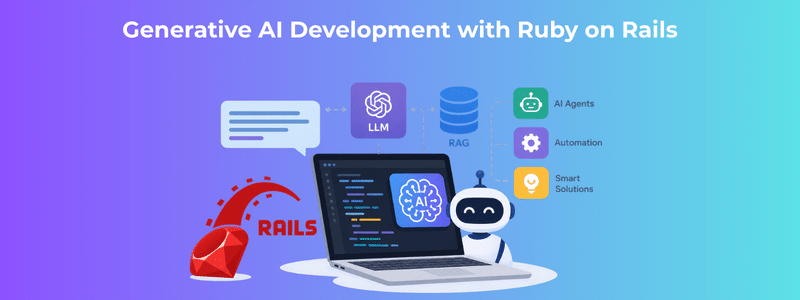
One of the most useful architectures for enterprise LLM applications is Retrieval-Augmented Generation, or RAG.
RAG allows an application to retrieve relevant information from an external knowledge base and provide that information to the LLM as context.
This is particularly useful when information is private or changes frequently.
For example, a Rails application for an enterprise could maintain an internal knowledge base containing policies, product documentation, procedures, and support materials. When a user asks a question, the application retrieves relevant content and provides it to the model.
The model can then generate an answer based on current business information rather than relying solely on its pretrained knowledge.
LLMs and Rails Databases
Rails applications frequently contain valuable business data in relational databases. CTOs need to determine carefully how this information should interact with LLM systems.
An LLM should not automatically have unrestricted access to the application’s database. Instead, the Rails application should retrieve only the information required for a particular operation and enforce existing authorization rules.
For example, if a customer asks about an order, Rails should authenticate the customer and retrieve only orders that the customer is authorized to view before passing relevant information to the AI system.
This separation between business logic and AI capabilities is important for security and data governance.
Background Processing and Asynchronous AI Workflows
Some LLM tasks can take longer than standard web requests, particularly document analysis, bulk processing, and complex multi-step workflows.
Rails background job systems can move these operations outside the main request-response cycle. A user can submit a document, for example, while a background worker processes the file and performs AI analysis.
This architecture can improve responsiveness and make it easier to handle workloads at scale.
Asynchronous processing can be especially useful for:
- Large document analysis
- Bulk content generation
- Data classification
- Embedding generation
- Report creation
- Batch AI processing
Considérations relatives à la sécurité
Security should be a primary consideration in any enterprise LLM integration.
CTOs should evaluate how prompts, retrieved documents, user inputs, and model outputs are handled. Sensitive information should not be unnecessarily transmitted to external services.
Important controls include authentication, authorization, encryption, secret management, input validation, output validation, logging, and access control.
The AI layer should also respect the application’s existing permission model. A user should never receive information simply because the AI model can retrieve or generate it.
Protecting Against Prompt Injection
Prompt injection is an AI-specific security risk in which malicious instructions attempt to manipulate model behavior.
For example, a user could attempt to instruct an AI assistant to ignore its original instructions or reveal information that it should not provide. Similar attacks can occur through untrusted documents used in RAG systems.
Mitigation strategies include separating trusted instructions from untrusted content, limiting the actions available to the model, validating tool calls, enforcing permissions outside the model, and requiring human confirmation for sensitive operations.
The key principle is that application code should enforce security decisions rather than relying solely on the LLM to follow instructions.
Handling Hallucinations
Sometimes LLMs will make up information that sounds plausible but is wrong. This is called hallucination.
CTOs need to know the acceptable error rate for business-critical AI applications and build in safeguards.
Potential mitigations include grounding responses in trusted sources, employing RAG, validating structured outputs, limiting the framework’s scope, displaying source information when appropriate, and involving human reviewers in high-risk workflows.
The higher the application output the more rigorous the validation and oversight by humans needs to be.
Data Privacy and Governance
Enterprise applications may handle personal information, financial data, intellectual property, customer records, and confidential business information.
Before integrating an LLM, organizations should understand how data flows through the system and determine what information can be shared with external services.
A governance framework should address:
- Data classification
- Data retention
- Contrôles d'accès
- Privacy requirements
- Vendor policies
- Journalisation des audits
- Data deletion
- Employee usage
- Model and provider management
AI governance should be integrated into the broader organization’s security and compliance strategy.
Performance et évolutivité
LLM calls have additional latency compared to traditional database or API calls. Thus, a CTO should think about performance right from the start.
Caching can help with repeated requests. Asynchronous interfaces can also provide feedback to the user about progress, and background jobs can be used for longer running operations.
Applications should also take into account provider rate limits and traffic spikes. The architecture should include proper failure handling and fallback strategies if an application becomes too dependent on an external model provider.
Managing LLM Costs
The cost of an LLM can scale enormously with more usage. Prices depend on model choice, number of requests, input size, output size, document processing, embeddings, and other services.
CTOs can control costs by selecting models that fit the complexity of the task, avoiding unnecessary calls, caching the right results, tuning prompts, limiting the length of the output, and monitoring usage.
Cost should be tracked at the feature/workflow level where possible. That in turn makes it easier to decide which AI capabilities deliver enough business value to justify the cost of running them.
Testing LLM-Powered Rails Applications
Traditional application testing remains important, but LLM applications require additional testing strategies.
Teams should test representative user inputs and evaluate whether responses meet defined quality requirements. Testing should cover normal use cases as well as ambiguous, malicious, unexpected, and adversarial inputs.
Important testing areas include:
- Functional testing
- Prompt testing
- Accuracy testing
- Security testing
- Tests de performance
- Regression testing
- Output validation
- Load testing
A reusable evaluation dataset can help teams compare AI performance when changing models, prompts, retrieval strategies, or application logic.
Monitoring Production AI Systems
Deployment is not the end of LLM integration. Production systems should be continuously monitored.
Useful metrics include:
- Response latency
- API errors
- Request volume
- Token usage
- Estimated AI cost
- User feedback
- Retrieval quality
- Failed workflows
- Safety incidents
Monitoring can help identify performance degradation, unexpected costs, inaccurate responses, and integration problems.
Building an LLM Abstraction Layer
It can be valuable for a CTO to avoid unnecessary vendor lock-in. Instead of having provider-specific API calls sprinkled throughout the Rails codebase, organisations can build an abstraction layer.
This layer can standardise things such as sending prompts, handling responses, tracking usage, and managing errors.
This kind of architecture can make it easier to swap out models or providers as artificial intelligence technology evolves.
It can also support different models for different tasks . For example, one model can be used for complex reasoning while another is used for simpler classification or summarisation tasks.
When Should a Business Integrate an LLM?
Start LLM integration with a well-defined business problem. CTOs should ask themselves whether the technology can improve a measurable outcome.
Signs could be too much manual work, lots of unstructured information, repetitive customer questions, inefficient search, content bottlenecks or workflows that require a lot of language processing.
The goal shouldn’t be ‘adding AI’ to an application. Instead, the goal should be to use AI where it can create real value.
Building an LLM Roadmap
A dedicated pilot can initiate a practical LLM implementation roadmap.
The first phase should include a statement of the business problem as well as concrete success criteria. Next phase should look at the existing data, modelling decisions, security requirements and the complexity of integration.
Then a small proof of concept can be built and tested with representative users and data. If the pilot proves its worth by delivering measurable results, the solution can then be deployed into production workflows and scaled up in a gradual manner.
This approach reduces risk and enables the organization to learn before making a larger investment.
Why Choose RailsCarma for LLM Integration?
RailsCarma helps companies build Ruby on Rails applications with modern AI capabilities with a strong focus on application architecture, scalability, security and maintainability.
From AI-powered assistants and intelligent search to RAG implementations, workflow automation, document processing and custom LLM integrations, an experienced Rails development team can help organisations identify suitable use cases and build them into existing or new applications.
Good AI implementation requires both knowledge of AI and good application engineering. RailsCarma can help bridge these areas through the combination of Développement Ruby on Rails practices and modern AI integration strategies.
Conclusion
Integrating LLM with Ruby on Rails can help businesses turn their traditional web applications into smart digital platforms. Rails offers a solid foundation to manage application logic, databases, authentication, APIs, background processing, and integrations, and LLMs bring capabilities such as natural language understanding, content generation, summarisation, intelligent search, and workflow automation.
For CTOs, the most important thing isn’t just about choosing an AI model. “Designing an architecture that balances business value, performance, security, scalability, cost and maintainability.
Successful implementation starts with a clearly defined business problem and follows the path This includes proper model selection, secure API integration, effective data handling, prompt and retrieval strategies, testing, monitoring, and continuous improvement.
By taking a systematic approach to integrating LLMs, organisations can easily add AI capabilities to their Ruby on Rails apps without compromising the robustness and maintainability of their existing technology stack. As LLM technology continues to evolve, a flexible and well-architected Rails application can give businesses a platform to incorporate new AI capabilities and build smarter digital experiences. To know more connect with RailsCarma.

 French
  English
  Japanese
  German
  Spanish
  Italian
  Swedish