
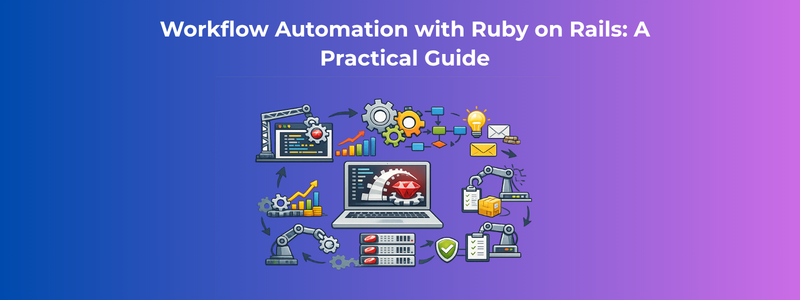
Dans le paysage numérique en constante évolution d’aujourd’hui, les entreprises recherchent sans cesse des moyens d’améliorer leur efficacité, de réduire les tâches manuelles et de rationaliser les tâches répétitives. L'automatisation des flux de travail est devenue une stratégie incontournable pour les organisations qui cherchent à accroître leur productivité tout en minimisant leurs coûts d'exploitation. De l'intégration des clients au traitement des factures, en passant par la gestion du personnel et le suivi des stocks, les flux de travail automatisés éliminent les goulots d'étranglement et garantissent le bon déroulement des processus métier.
Parmi les nombreuses technologies disponibles pour développer des solutions d'automatisation des flux de travail, Ruby on Rails (RoR) se distingue comme l'un des frameworks les plus puissants et les plus conviviaux pour les développeurs. Réputé pour sa philosophie « convention plutôt que configuration », ses capacités de développement rapide et son écosystème très complet, Ruby on Rails permet aux entreprises de créer des applications d'automatisation des flux de travail évolutives en moins de temps, sans compromettre la qualité.
Que vous soyez une start-up souhaitant automatiser ses opérations internes ou une grande entreprise cherchant à moderniser ses systèmes existants, Ruby on Rails vous offre tous les outils nécessaires pour créer des plateformes d'automatisation des flux de travail fiables, sécurisées et intelligentes.
Ce guide pratique aborde l'automatisation des flux de travail, explique pourquoi Ruby on Rails constitue un excellent choix, présente ses principales fonctionnalités, propose des stratégies de mise en œuvre, illustre son utilisation à travers des cas concrets et expose les meilleures pratiques pour la création de solutions d'automatisation.
Qu'est-ce que l'automatisation des flux de travail ?
L'automatisation des flux de travail consiste à utiliser des logiciels pour exécuter automatiquement des processus métier selon des règles et des conditions prédéfinies. Au lieu de recourir à une intervention manuelle, les tâches sont déclenchées automatiquement lorsque des événements spécifiques se produisent.
Par exemple:
- Attribution automatique des tickets d'assistance aux agents disponibles
- Envoi d'e-mails de bienvenue après l'inscription des utilisateurs
- Émission des factures une fois l'achat finalisé
- Valider les demandes de congés conformément aux politiques de l'entreprise
- Synchronisation des données entre plusieurs applications métier
L'objectif principal est de réduire les tâches manuelles répétitives tout en améliorant la rapidité, la cohérence et la précision.
Pourquoi les entreprises ont besoin de l'automatisation des processus métier
Les entreprises de tous les secteurs sont confrontées à des défis opérationnels communs :
- Des processus manuels chronophages
- Erreurs humaines dans les tâches répétitives
- Retards dans les autorisations
- Manque de communication entre les services
- Une gestion des données inefficace
- Opérations de mise à l'échelle de la difficulté
L'automatisation des flux de travail permet de résoudre ces problèmes en :
- Accélérer les opérations commerciales
- Améliorer la collaboration
- Réduction des coûts d'exploitation
- Améliorer la productivité des employés
- Améliorer l'expérience client
- Garantir la cohérence des processus
À mesure que les entreprises se développent, l'automatisation devient une nécessité plutôt qu'un luxe.
Pourquoi Ruby on Rails est idéal pour l'automatisation des flux de travail
Ruby on Rails s'est forgé une réputation comme l'un des frameworks les plus rapides pour le développement d'applications d'entreprise.
Voici les raisons pour lesquelles cette solution excelle dans l'automatisation des flux de travail.
1. Développement rapide
Ruby on Rails suit le « Convention plutôt que configuration » (CoC) philosophie qui permet aux développeurs de se concentrer sur la logique métier plutôt que sur des tâches de codage répétitives.
Les conventions prédéfinies réduisent considérablement le temps de développement, ce qui facilite la mise en place rapide de systèmes d'automatisation.
2. Architecture MVC
Rails suit l'architecture Modèle-Vue-Contrôleur, ce qui garantit :
- Base de code bien structurée
- Meilleure facilité de maintenance
- Débogage simplifié
- Conception d'applications évolutives
Cette structure s'avère particulièrement utile lorsque les processus deviennent de plus en plus complexes.
3. Un écosystème riche en pierres précieuses
Ruby on Rails propose des milliers de gemmes open source qui facilitent le développement d'outils d'automatisation.
Parmi les perles les plus appréciées, on peut citer :
- Sidékiq
- Travail retardé
- Offre d'emploi en cours
- Pundit
- Concevoir
- AASM
- Piste de papier
- Chaque fois que
Ces outils permettent d'éviter d'avoir à développer des fonctionnalités courantes à partir de zéro.
4. Excellente prise en charge des bases de données
Les systèmes d'automatisation impliquent souvent le traitement de grandes quantités de données structurées.
Rails s'intègre parfaitement avec :
- PostgreSQL
- MySQL
- SQLite
- MariaDB
Son ORM Active Record simplifie les interactions avec la base de données tout en garantissant d'excellentes performances.
5. Intégration facile de l'API
L'automatisation moderne des flux de travail fonctionne rarement de manière isolée.
Rails s'intègre facilement à :
- CRM
- Passerelles de paiement
- Logiciel de gestion des ressources humaines
- Systèmes ERP
- Plateformes marketing
- Logiciel de comptabilité
- Services cloud
Éléments clés de l'automatisation des flux de travail dans Ruby on Rails
Les applications d'automatisation des flux de travail qui font leurs preuves comportent généralement plusieurs éléments essentiels.
Moteur de règles métier
Les règles métier déterminent le fonctionnement des workflows.
Par exemple:
“ Si le montant de la facture dépasse 50 000 ₹, envoyez une demande d'autorisation au responsable financier. ”
Ces règles peuvent être configurées de manière dynamique pour plus de souplesse.
Traitement des tâches en arrière-plan
Toutes les tâches ne doivent pas nécessairement s'exécuter lors des requêtes des utilisateurs.
Rails prend en charge le traitement asynchrone à l'aide de :
- Sidékiq
- Offre d'emploi en cours
- Demander
En voici quelques exemples :
- Notifications par e-mail
- Génération de rapports
- Importations de données
- Traitement des fichiers
- Synchronisation des API
Les tâches en arrière-plan améliorent l'expérience utilisateur tout en réduisant les temps de réponse du serveur.
Notifications
L'automatisation des processus repose en grande partie sur la communication.
Rails peut envoyer :
- E-mails
- Alertes par SMS
- Notifications push
- Messages Slack
- Alertes Microsoft Teams
Des notifications en temps réel permettent de tenir les parties prenantes informées à chaque étape du processus.
Contrôle d'accès basé sur les rôles
Les systèmes d'automatisation impliquent plusieurs utilisateurs ayant des responsabilités différentes.
Exemples :
- Salarié
- Responsable
- RH
- Finances
- Administrateur
Rails propose des frameworks d'authentification et d'autorisation robustes permettant de gérer les autorisations en toute sécurité.
Journaux d'audit
Les entreprises ont souvent besoin d'une visibilité totale sur les actions automatisées.
Rails permet aux développeurs d'enregistrer :
- Qui a approuvé les demandes ?
- Lorsque des changements sont survenus
- Valeurs précédentes
- Historique des flux de travail
Les pistes d'audit renforcent la responsabilité et favorisent la conformité réglementaire.
Cas d'utilisation courants de l'automatisation des flux de travail
Ruby on Rails est au cœur de l'automatisation dans de nombreux secteurs d'activité.
Intégration des clients
Les processus d'intégration automatisés permettent :
- Créer des comptes utilisateurs
- Vérifier les e-mails
- Désigner des chargés de clientèle
- Programmer l'envoi d'e-mails de bienvenue
- Créer des fiches clients
Cela permet d'offrir une expérience d'intégration fluide.
Automatisation des ressources humaines
Les services des ressources humaines automatisent :
- Autorisations de congés
- Intégration des nouveaux collaborateurs
- Processus de gestion de la paie
- Évaluations de performance
- Vérification des documents
L'automatisation permet de réduire la paperasse et les frais généraux administratifs.
Gestion du pipeline commercial
Les équipes commerciales automatisent :
- Affectation de responsable
- Rappels de suivi
- Élaboration de propositions
- Mises à jour du CRM
- Rapports sur les ventes
Cela permet aux commerciaux de se concentrer sur la conclusion des ventes.
Traitement des factures
Les équipes financières automatisent :
- Émission de factures
- Processus de validation
- Rappels de paiement
- Calculs fiscaux
- Information financière
Les tâches comptables manuelles sont ainsi réalisées beaucoup plus rapidement.
Service client
Les systèmes d'assistance automatisent :
- Acheminement des tickets
- Règles d'escalade
- Réponses automatiques
- Surveillance des accords de niveau de service (SLA)
- Collecte d'avis
Les clients bénéficient de réponses plus rapides, tandis que les équipes d'assistance travaillent plus efficacement.
Gestion des stocks
Les commerces de détail se tournent vers l'automatisation :
- Suivi des stocks
- Bons de commande
- Notifications aux fournisseurs
- Alertes de stock insuffisant
- Synchronisation des entrepôts
L'automatisation permet de réduire au minimum les ruptures de stock et les excédents de stock.
Comment Ruby on Rails gère la logique complexe des flux de travail
Les processus métier comportent souvent plusieurs niveaux d'approbation et plusieurs étapes décisionnelles.
Prenons l'exemple d'un processus d'achat :
Un salarié soumet une demande d'achat.
↓
Avis sur les responsables de service.
↓
Le service des finances vérifie le budget.
↓
Le service des achats approuve le fournisseur.
↓
Bon de commande généré.
↓
Le fournisseur a été informé.
↓
Stock mis à jour.
↓
La comptabilité enregistre les opérations.
Les modèles Rails peuvent représenter chaque étape, tandis que les machines à états gèrent efficacement les transitions.
Cette approche structurée simplifie même les processus de travail les plus complexes.
Intégration de services tiers
L'automatisation des flux de travail repose souvent sur des applications externes.
Ruby on Rails s'intègre avec :
Plateformes de paiement
- Rayure
- Razorpay
- PayPal
Systèmes CRM
- Salesforce
- HubSpot
- Zoho CRM
Outils de communication
- Slack
- Microsoft Teams
- Twilio
Stockage dans le cloud
- AWS S3
- Google Cloud Storage
- Stockage Blob Azure
Plateformes de messagerie électronique
- SendGrid
- Mailgun
- Amazon SES
Les intégrations API permettent aux flux de travail de s'étendre de manière transparente à plusieurs systèmes d'entreprise.
Création d'un workflow d'automatisation avec Ruby on Rails
Un projet concret d'automatisation des flux de travail suit généralement les étapes suivantes.
Étape 1 : Comprendre les besoins métier
Identifier :
- Processus actuel
- Goulets d'étranglement liés aux opérations manuelles
- Étapes décisives
- Hiérarchie des autorisations
- Résultats attendus
Des exigences claires permettent de réduire les modifications apportées au cours du développement.
Étape 2 : Conception du flux de travail
Créez des schémas illustrant :
- Déroulement du processus
- Rôles des utilisateurs
- Événements déclencheurs
- Logique conditionnelle
- Notifications
La planification visuelle facilite la mise en œuvre.
Étape 3 : Créer des modèles de base de données
Créez des modèles représentant :
- Utilisateurs
- Tâches
- Demandes
- Étapes du processus
- Journaux d'activité
- Notifications
Une conception adéquate de la base de données favorise l'évolutivité.
Étape 4 : Mise en œuvre de la logique métier
Les contrôleurs et les objets de service exécutent :
- Validation
- Autorisations
- Transitions d'états
- Notifications
- Appels d'API
Le fait de conserver une logique métier modulaire facilite la maintenance.
Étape 5 : Ajouter des tâches en arrière-plan
Transférez les tâches gourmandes en ressources vers le traitement en arrière-plan.
Exemples :
- Envoi d'e-mails
- Création de rapports
- Téléversement de fichiers
- Synchronisation des données
Cela permet aux applications de rester réactives.
Étape 6 : Tout tester
Les systèmes d'automatisation nécessitent des tests approfondis.
Rails prend en charge :
- Tests unitaires
- Tests d'intégration
- Tests système
- Tests d'API
Les tests permettent de s'assurer que les flux de travail fonctionnent correctement dans différents scénarios.
Considérations relatives à la sécurité
Les systèmes d'automatisation traitent souvent des informations commerciales sensibles.
Ruby on Rails intègre des protections contre :
- Injection SQL
- Cross-Site Scripting (XSS)
- Falsification de requête intersite (CSRF)
- Falsification des paramètres
Les développeurs doivent également mettre en œuvre :
- Authentification multifactorielle
- Chiffrement des données
- Autorisations basées sur les rôles
- Authentification sécurisée via l'API
- Journalisation des audits
La sécurité ne devrait jamais être reléguée au second plan.
Conseils pour optimiser les performances
Les grandes plateformes d'automatisation traitent chaque jour des milliers d'événements liés aux flux de travail.
Pour garantir des performances optimales :
- Optimiser les requêtes de base de données
- Mettre en cache les données fréquemment consultées
- Utiliser des processus d'arrière-plan
- Tables de base de données d'index
- Pagination de grands ensembles de données
- Surveiller les performances du serveur
- Optimiser les appels API
Lorsqu'il est correctement optimisé, Rails offre une excellente évolutivité.
Meilleures pratiques pour l'automatisation des flux de travail avec Ruby on Rails
Les projets d'automatisation couronnés de succès s'appuient sur des pratiques de développement éprouvées.
Séparer la logique métier
Utilisez des objets de service plutôt que d'intégrer une logique complexe dans les contrôleurs.
Cela améliore la lisibilité et facilite les tests.
Rendre les flux de travail configurables
Évitez de coder en dur les règles de validation.
Permettre aux administrateurs de modifier les flux de travail sans modifier le code de l'application.
Créer des composants modulaires
Les modules réutilisables simplifient la maintenance et les améliorations futures.
Consigner chaque action importante
Les journaux d'activité permettent notamment :
- Débogage
- Conformité
- Rapports
- Audit
Une journalisation complète améliore la transparence du système.
Gérer les défaillances avec élégance
Les API externes peuvent parfois présenter des dysfonctionnements.
Mise en œuvre :
- Mécanismes de nouvelle tentative
- Notifications d'erreur
- Procédures de restauration
- Surveillance des exceptions
Une automatisation fiable anticipe les pannes.
Suivre les performances du flux de travail
Suivez des indicateurs tels que :
- Durée moyenne d'exécution
- Tâches ayant échoué
- Longueur de la file d'attente
- Temps de réponse de l'API
- Retards dans les autorisations
Une surveillance continue permet d'améliorer l'efficacité opérationnelle.
L'avenir de l'automatisation des flux de travail avec Ruby on Rails
L'automatisation des processus évolue rapidement grâce aux technologies émergentes.
Les futures plateformes d'automatisation intègrent de plus en plus :
- Intelligence artificielle
- Apprentissage automatique
- Analyse prédictive
- Automatisation robotisée des processus (RPA)
- Traitement intelligent des documents
- Traitement du langage naturel
- Analyses en temps réel
Ruby on Rails s'intègre efficacement aux services d'IA modernes et aux plateformes cloud, ce qui en fait un outil particulièrement adapté au développement de solutions de flux de travail intelligentes de nouvelle génération.
Les entreprises vont désormais au-delà de la simple automatisation basée sur des règles pour se tourner vers des systèmes capables de prendre des décisions en tenant compte du contexte, d'identifier les goulots d'étranglement dans les processus et d'améliorer en permanence leurs opérations. Rails offre la flexibilité nécessaire pour créer et faire évoluer ces écosystèmes d'automatisation avancés.
Conclusion
L'automatisation des flux de travail est devenue un investissement stratégique pour les organisations qui cherchent à gagner en efficacité, à améliorer la précision de leurs processus et à assurer l'évolutivité de leurs opérations. En automatisant les tâches répétitives et en rationalisant les processus métier complexes, les entreprises peuvent réduire leurs coûts, améliorer leur productivité et offrir une meilleure expérience tant à leurs collaborateurs qu'à leurs clients.
Ruby on Rails reste l'un des frameworks les plus efficaces pour développer des applications d'automatisation des flux de travail grâce à ses capacités de développement rapide, son architecture épurée, son écosystème étendu, ses fonctionnalités de sécurité robustes et son intégration transparente avec des services tiers. Qu'il s'agisse d'automatiser les processus RH, l'intégration des clients, les validations financières, la gestion des stocks ou les opérations à l'échelle de l'entreprise, Rails permet aux entreprises de créer en toute confiance des plateformes d'automatisation fiables et évolutives.
Pour les entreprises qui souhaitent accélérer leur transformation numérique grâce à l'automatisation intelligente des flux de travail, RailsCarma possède une expertise approfondie dans le développement Ruby on Rails et aide les entreprises à concevoir, développer et déployer des solutions d'automatisation sur mesure qui garantissent leur réussite opérationnelle à long terme.




 French
  English
  Japanese
  German
  Spanish
  Italian
  Swedish