
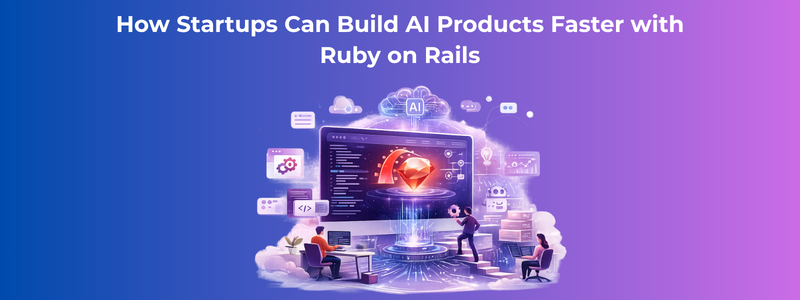
AI is more than something that used to be in sci-fi movies. AI is the cutting edge for many industry innovations. Startups have a plethora of options when choosing AI tools to aid in the solving of challenges and in the differentiation of their business advantages: intelligent chatbots, recommendation engines, predictive analytics, document processing, and multiple generative AI subspecialties. Startups are able to use tools and systems to help them build AI-powered Products. The right model for machine learning is only a small piece of the work. Startups also need to have the infrastructure to support, secure, and make available the AI Product to potential users.
Time to market is the most important component for a new startup. Startups that are able to realize a Minimum Viable Product (MVP) to the market aid them in getting feedback from users and in making improvements in the iterative design process. Choosing the correct development framework can help give a startup the advantage they need to succeed.
Ruby on Rails (RoR) has established a long standing good reputation as one of the fastest frameworks for new web development for startups for many good reasons: convention-over-configuration, a huge library ecosystem, and rapid application development. Startups are even able to spend less time on backend development.
In this guide, we are going to talk about positive reasons that help certify that Ruby on Rails is the perfect framework for AI for Startups: How it speeds up the development of products, positive reasons and certification of frameworks for development of AI Products, and a few reasons Rails is used for development of AI Products for many successful companies.
Challenges AI Startups Face & How Speed Solves Them
Short timeframes to market are a must for competitive advantage in the quickly evolving AI industry and startup speed is more crucial than even more typically, due to:
- Limited funding
- Small development teams
- Tight launch deadlines
- Constant market competition
- Rapid technology changes
- Customer expectations for continuous innovation
- Luckily, speed provides the following benefits to AI startups:
- Verifying ideas
- Collecting feedback from actual users
- Attracting investors
- Generating income early in the startup lifecycle
- Improving products based on feedback
Rapid product development & launch frameworks provide the best paths to early AI startup success.
Why Ruby on Rails is Perfect for AI Product Development
Even though Python frameworks such as TensorFlow and PyTorch are the favorites for developing AI models, the frameworks needed for building the surrounding application such as user authentication, dashboards, APIs, billing, and workflow management are equally important.
Ruby on Rails is the best framework for developing surrounding AI applications.
Quick Development of MVP
With the philosophy of Convention over Configuration, Ruby on Rails requires minimal coding and makes application development faster compared to other frameworks.
Startups are able to quickly create:
- User registration
- Admin dashboards
- Subscription management
- AI request interfaces
- User payment interfaces
- User management
- Admin interfaces
- AI
Instead of developing the surrounding application from scratch, teams can work on the AI features.
Neat and Clean MVC
The MVC architecture promotes neat organization and simplifies the maintenance of an application.
Ruby on Rails combines the following advantages:
Scalability
Expedited Development of Features
Increased Collaboration
Less time is lost making the framework and more time is spent on the features especially the AI features.
Integration of AI APIs Made Easy
Expanding APIs are the easier routes for AI startups.
Rails work with APIs of:
- OpenAI
- Anthropic
- Google AI
- Azure AI
- AWS AI Services
- Hugging Face
Building a secure API, processing AI and displaying results in an application is easy.
Ecosystem of Gems
Speeding development, Ruby on Rails has a large selection of libraries (gems).
Some gems include:
- Devise for authentication
- Sidekiq for background jobs
- Active Job for asynchronous tasks
- Pundit for authorization
- Kaminari for pagination
- PaperTrail for version tracking
Faster Product Development with Rails
Ruby on Rails accelerates nearly every stage of product development.
Authentication Ready Out of the Box
Every AI application needs secure user management.
Rails allows developers to quickly implement:
- User registration
- Login systems
- Password recovery
- Email verification
- Multi-factor authentication
Instead of spending weeks building authentication, startups can focus on AI functionality.
Database Management Made Easy
AI products generate significant amounts of data.
Rails uses Active Record ORM to simplify database operations.
Developers can easily manage:
- User accounts
- AI prompts
- Response history
- Billing records
- Usage analytics
- Feedback
This reduces backend complexity.
API-First Development
Many AI startups build API-first platforms.
Rails supports:
- REST APIs
- JSON responses
- API authentication
- Versioning
- Webhooks
This enables startups to serve web applications, mobile apps, and third-party integrations from a single backend.
Background Processing
AI requests often require longer processing times.
Rails supports asynchronous execution using:
- Sidekiq
- Active Job
- Resque
Background processing handles:
- AI inference
- Document analysis
- Report generation
- Bulk processing
- Notifications
Users enjoy faster response times while heavy workloads run independently.
Building Scalable AI Applications
Successful AI startups must prepare for growth from day one.
Ruby on Rails supports scalability through:
- Modular architecture
- Horizontal scaling
- Cloud deployment
- Containerization
- Database optimization
- Caching
- Background workers
As user demand increases, Rails applications can scale efficiently without requiring complete redevelopment.
Integrating AI Models into Rails Applications
AI functionality is typically delivered through APIs or microservices.
A common architecture includes:
User Interface
↓
Ruby on Rails Backend
↓
Authentication
↓
Business Logic
↓
AI API or Machine Learning Service
↓
Processed Response
↓
User Dashboard
This separation allows developers to improve AI models independently without disrupting the web application.
Cloud Deployment for AI Startups
Cloud platforms simplify infrastructure management.
Rails applications commonly deploy on:
- Amazon Web Services (AWS)
- Microsoft Azure
- Google Cloud Platform
- DigitalOcean
- Heroku
Cloud infrastructure offers:
- Automatic scaling
- Load balancing
- Secure storage
- Continuous deployment
- High availability
These capabilities support growing AI businesses.
Security Considerations for AI Products
AI platforms often manage sensitive business and customer information.
Ruby on Rails provides protection against:
- SQL Injection
- Cross-Site Scripting (XSS)
- Cross-Site Request Forgery (CSRF)
- Session hijacking
Additional security best practices include:
- OAuth authentication
- API key protection
- Role-based permissions
- Data encryption
- Secure API gateways
- Audit logs
Strong security builds customer trust and supports regulatory compliance.
Performance Optimization Tips
AI applications require careful performance optimization.
Recommended practices include:
Cache Frequent Requests
Store commonly requested AI outputs to reduce API costs and response times.
Optimize Database Queries
Use indexing and efficient queries for prompt history, user data, and analytics.
Queue Long-Running Tasks
Avoid blocking user requests by processing AI tasks in the background.
Monitor Application Health
Track:
- API latency
- Queue sizes
- Memory usage
- Error rates
- Database performance
Monitoring enables proactive optimization.
Best Practices for Building AI Products with Ruby on Rails
Start with a Focused MVP
Avoid building every feature at once.
Launch with core functionality and improve based on user feedback.
Use External AI Services Initially
Rather than training expensive models, integrate proven AI APIs.
This reduces costs and accelerates development.
Design for Scalability
Build modular services that allow components to evolve independently.
Future expansion becomes much easier.
Automate Testing
Rails supports:
- Unit tests
- Integration tests
- System tests
- API tests
Reliable testing reduces bugs and improves release confidence.
Continuously Gather User Feedback
AI products improve through iteration.
Collect:
- User ratings
- Prompt effectiveness
- Feature requests
- Performance metrics
Customer insights guide future development.
Common Startup Use Cases
Ruby on Rails powers AI startups across numerous industries.
Healthcare
Applications include:
- Medical transcription
- Appointment assistants
- Diagnostic support
- Patient communication
Finance
AI solutions automate:
- Fraud detection
- Credit scoring
- Financial forecasting
- Investment recommendations
Education
AI enhances:
- Personalized learning
- Homework assistance
- Automated grading
- Content generation
E-commerce
Businesses deploy AI for:
- Product recommendations
- Inventory forecasting
- Customer support
- Personalized marketing
Legal Services
Automation supports:
- Contract review
- Document summarization
- Compliance analysis
- Legal research
Rails provides the infrastructure needed for these sophisticated AI applications.
The Future of AI Startups with Ruby on Rails
AI technology continues evolving at an unprecedented pace.
Emerging trends include:
AI agents
- Autonomous workflows
- Multi-modal AI
- Personalized assistants
- Real-time analytics
- Retrieval-Augmented Generation (RAG)
- AI-powered SaaS platforms
Ruby on Rails integrates seamlessly with these innovations by serving as the backbone that manages users, workflows, security, billing, and business logic while AI models handle intelligent processing.
This combination enables startups to innovate rapidly without sacrificing reliability or scalability.
Why Startups Continue Choosing Ruby on Rails
Many successful startups have selected Ruby on Rails because it enables:
- Faster product launches
- Lower development costs
- High developer productivity
- Easier maintenance
- Rapid feature iteration
- Excellent scalability
- Secure application development
- Strong community support
For startups operating with limited resources and ambitious goals, these advantages translate directly into shorter development cycles and faster market validation.
Conclusion
Building an AI product is more than adding advanced machine-learning algorithms. It means building a usable, scalable, and secure app that incorporates those algorithms. Because of its organized architecture and rapid ease of integration, Rails is one of the best solutions for start-ups integrating AI into a product. Also with ROR, the AI product that is built will have seamless API integrations and a product that start-ups are able to iterate easily.
Being able to bring AI products to the market quickly that generate value for customers is simply Rails’ combination with contemporary AI services and innovation. This is especially true for developing AI chatbots, intelligent document processors, recommendation engines, predictive analytics and/or advanced SaaS solutions.
For start-ups, RailsCarma is a great partner for leveraging ROR to develop scalable, innovative AI apps that help the start-up grow and be successful with a variety of services and solutions.

 English
  Japanese
  German
  French
  Spanish
  Italian
  Swedish