
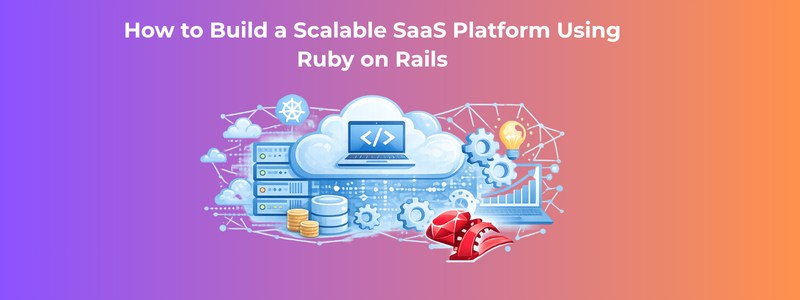
Today, the world is no longer about hastened product launch to build a Software-as-a-Service platform. In a world driven by competition in the digital realm, SaaS products need to be developed with scalability, growth of users, expansion of features, performance pressures and long-term maintainability from day one. Scalability must be built into the architecture at an early stage; a platform that works like a charm for one hundred users may go down with ten thousand.
To founders, enterprises, and product teams, scalability looks beyond server capacity. It talks about the response time of the application, how quickly databases respond to load, how background processes are dealt with, how code can be refactored/rewritten while still being maintainable, and much more in accordance with infrastructure scalability as business demand changes.
Ruby on Rails still provides one of the more pragmatic options for SaaS product development among modern frameworks, as it does offer speed to develop combined with mature conventions and ecosystem support, along with proven patterns that aid scaling effectively. Plenty of large SaaS products worldwide that started on top of Rails have shown that the framework can scale very well with proper architecture decisions.
The latest industry analysis still indicates an impressive degree of relevancy where Rails is concerned in terms of being capable of rapid development, its plethora of gems, and compatibility with cloud-native architectures for Rapid Enterprise SaaS Environments.
The issue is no longer whether Rails can scale for businesses launching their own SaaS products. The real question then becomes how to build the platform right from the start so scaling is a known quantity, not agonizing.
Why It Still Is a Strong SaaS Development Framework?
The top reason why SaaS companies select Rails is how quickly a production-ready product can be developed.
As you might know, Rails is the framework for a convention over configuration approach — it means that we have much less setup decisions to take and we can focus on business logic. Rather than crafting repeated patterns, teams build with reusable frameworks that speed development.
This is particularly useful in SaaS due to the speed of product cycles.
Teams often need to:
- Launch MVPs quickly
- Test pricing models
- Release features continuously
- Modify tasks according to user data
Rails will handle this velocity without losing structure.
Additionally, its mature ecosystem means developers can use tried and tested tools for authentication, payments, background jobs, APIs, and testing instead of reinventing the wheel.
SaaS Architecture Must Start With Multi-Tenancy Planning
Typically, a scalable SaaS platform is accessed by numerous customers (by means of a singular application environment).
This is known as multi-tenancy. Multi-tenancy means that a single codebase can be run to serve different organizations while having all the data isolated in a secure environment.
The tenancy model in Rails has to be designed early as it is costly to change from one tenant style architecture later.
The main approaches include:
- Shared database with tenant identifiers
- Separate schemas per tenant
- Separate databases for enterprise isolation
Reduction of operational complexity is why early SaaS companies often take a shared database with a tenant-scoping approach. Of course, enterprise SaaS products go on to something much lower compatibility models once it goes after compliance. The core requirement here is fine-grained tenant-level access control on every model and query. Risk of data leakage increases the lack of disciplined tenant architecture.
The Databases That Train Old SaaS For Long Term Performance
Many SaaS products collapse under scale not because of application code but because their database design faded with time as the product matured.
The database architecture for an Rails SaaS platform that is scalable, must be treated as a first-class citizen of your design. The database architecture for a scalable Rails SaaS platform must be treated as a first-class citizen of your design, particularly for any SaaS development company building applications expected to handle long-term growth, high traffic, and evolving customer demands.
That is, designing tables according to current load as well as future workload.
Important considerations include:
- Proper indexing
- Query efficiency
- Foreign key integrity
- Partitioning readiness
- Controlled associations
When users increase, large joins over multiple tables will be serious performance bottleneck. Studies continue to demonstrate that most of the engineering performance issues around Rails are more related to poorly performing queries than any constraints posed by framework.
This implies that careful schema planning frequently trumps aggressive investment in infrastructure.
Background Jobs Are Key to SaaS Scalability
No user should ever wait on a SaaS platform to perform tasks that can happen asynchronously. All operations should start transitioning to background processing systems, like email delivery, PDF generation, exports, notifications, data syncing and billing events. Background job frameworks that are efficient in supporting this type of functionality is what Rails delivers.
Popular implementations often use:
- Sidekiq
- Active Job
- Redis-backed queues
This keeps user-facing interactions fast. Users get to work once applications are ready instead of waiting for heavy processing, and systems run non-blocking background task completion. Background job design is crucial for SaaS products that experience increasing user activity.
Benefits of API-First Design for the Future Flexibility of Your SaaS
Very few modern SaaS products are web-only.
Many later expand into:
- Mobile applications
- Third-party integrations
- Partner dashboards
- External automation tools
This is why API-first architecture enhances future-proofing.
Rails has a solid basis for building APIs (structured controllers, serializers and versioning strategies).
A SaaS API that scales has to do these things:
- Authentication discipline
- Version control
- Rate limiting
- Consistent response structure
If you do not plan your API versioning, you cannot control an expanding API afterwards.
Why Caching is Required for High Traffic SaaS Apps
However, their usage leads to repeated access to the database, leading to unnecessary load as they are built every time. Caching helps reduce this pressure. There are several caching strategies built into Rails, which provide massive performance gains.
These include:
- Fragment caching
- Low-level caching
- Query result caching
- Redis caching
Caching becomes crucial for dashboards, reports, pricing views, and similar read-heavy endpoints across time. But caching, which can create issues of trust in SaaS environments due to stale data, must be done correctly. To cache selectively, not blindly.
Horizontal Scalability Demands Running Stateless Applications
So, what you should never do for a scalable SaaS platform is to heavily rely on a single application server. Given that situation, it should promote horizontal scaling—where we can focus on quickly adding more application instances.
Stateless patterns help with scaling of Rails applications.
This means:
- Local memory shouldn’t affect session storage
- For Upload/Download shares → Shared object storage
- State that is meant to be temporary will need to move to external services
- Stateless design that is cloud-ready lets you safely burn the traffic through several servers.
- This becomes essential during spikes in movement.
Modern Rails SaaS Growth using Cloud Infrastructure
SaaS scalability is heavily dependent on infrastructure decisions. The elasticity provisioned by cloud systems encourages Rails applications, which place on cloud-native environments.
Among the popular patterns for infrastructure are containerized deployment and managed services.
This allows teams to scale:
- Compute separately
- Databases independently
- Background jobs dynamically
Even in the recent platform trends shows an increase of popularity to container-based Rails deployment for SaaS because this approach gives you better control over releasing and also enables you to scale-up without break down.
Future migration is easier with cloud-native design.
Security that Scales: Secure authentication and authorization
As SaaS platforms expand, security architecture becomes more complex. Enterprise SaaS usually requires more control than a simple login system, even in the early days. While Rails has robust authentication solutions, in high-scalability SaaS application you will also require better authorization models.
This often includes:
- Role-based permissions
- Team-level access
- Feature restrictions
- API token security
Customer organizations tend to need more granular access rules as they grow.
SaaS Product Scalability Is Core to Billing Architecture
Eventually, a SaaS without billing logic becomes underpowered as it tries to scale.
Billing systems must support:
- Subscription plans
- Usage pricing
- Trial periods
- Invoice handling
- Payment retries
Rails has a rich payment libraries to integrate into subscription-billing systems.
The billing logic, however, needs to be kept as isolated & clean from the business logic as we can, so that changing prices does not bring down the entire application.
The significance of which becomes apparent when making product monetization transitions.
Why Do You Need Scalable SaaS Operations — Essential Aspect of Observability
More traffic on SaaS means harder debugging without visibility. Observability should be part of any scalable platform from day one.
This includes:
- Application logging
- Performance monitoring
- Error tracking
- Queue visibility
- Database metrics
When you do not monitor your growth-related problems, these issues only become apparent after customers fail.
Observability lets teams correct problems before users raise alarm bells.
Continuous Deployment Increases SaaS Product Velocity
SaaS products evolve constantly. So a release system needs to be safely for a scalable platform. Rails is well suited to continuous deployment pipelines that keep updates moving that *do* not cause interruptions.
Mature deployment workflows typically include:
- Automated testing
- Staging environments
- Deployment rollback
- Health checks
The more you deploy safely, the quicker your products are to respond.
How Codebase Discipline Impacts Long Term Rails Scalability
Codebase chaos is one of the most significant hidden risks in a SaaS.
Fast development is great, but undisciplined fast code is hard code — and Rails encourages that.
A scalable SaaS codebase requires:
- Service object patterns
- Clear model boundaries
- Controlled callbacks
- Modular business logic
New features slow down as time goes without structure.
So, when we mention scalability, part of that picture is Developer Scalability as much as System Scalability.
Performance Optimization Must Be Continuous
As with any SaaS platform, it will never be fully optimized forever.
When features grow, so does the performance nature.
Rails teams must continuously evaluate:
- Slow queries
- Memory use
- Response times
- Queue delays
Optimization is not a single flash of lightning. It moves the needle on product maturity. States that Rails is still an important part of SaaS Growth. Its importance has remained high because Rails success is built on architecture maturity which should be independent of latest fads that come with newer frameworks.
Rails provides a steady base for teams to accelerate, while maintaining engineering sanity. Its main benefit is still what product complexity it absorbs without much configuration. This means quick validation to the SaaS Founders without compromising future level.
How RailsCarma helps in building Scalable SaaS
Its SaaS engineering capabilities include:
- Multi-tenant SaaS architecture
- Custom Rails application development
- Cloud-native deployment
- API-first product engineering
- Performance optimization
- SaaS modernization and scaling support
It helps businesses to step beyond the MVP mindset and develop SaaS platforms that are ready for prolonged product growth.
Conclusion
In building a scalable SaaS (Software as a Service) platform using Ruby on Rails, selecting the correct framework for your solution is not enough. It needs disciplined architecture across databases, APIs, background jobs, infrastructure, security, billing and deployment.
All of these things, if designed well, mean Rails stays one of the most pragmatic and battle-tested SaaS growth frameworks because it backs rapid delivery that defers a lot of long-term engineering cost.

 English
  Japanese
  German
  French
  Spanish
  Italian
  Swedish